Top Container Shipping Companies Container Size 2026 |Freight Carrier Guide
Wenn es um den globalen Handel geht, ist die Wahl des richtigen Containerschifffahrtsunternehmen kann erhebliche Auswirkungen auf die Kosten, die Geschwindigkeit und die Zuverlässigkeit Ihrer Sendungen haben. Ganz gleich, ob Sie aus China importieren oder nach Europa exportieren – für eine reibungslose Logistikplanung ist es unerlässlich, die wichtigsten Akteure der Versandbranche zu kennen.
Here’s a guide to some of the top container shipping companies in 2026 and what makes them reliable partners for international freight.
1. Maersk Line (MSK SHIPPING)
Falls Sie schon einmal in der Import- und Exportgeschäft, dann kennen Sie sicherlich Maersk.
APM-Maersk ist ein dänisches Unternehmen mit Hauptsitz in Kopenhagen.
Außerdem unterhält das Unternehmen Niederlassungen in mehr als 130 Ländern und Regionen weltweit.
Derzeit ist Maersk das führende Unternehmen unter den zehn weltweit größten Containerschifffahrtsunternehmen.
Maersk ist die weltweit größte Containerschifffahrtsgesellschaft. Das Unternehmen ist bekannt für sein umfangreiches Netzwerk, seine digitalen Ortungstools und integrierte Logistiklösungen, bietet das Unternehmen weltweit umfassende Versanddienstleistungen an.
MSK-Containergröße
20 Containerspezifikationen
| Beschreibung | Imperial | Metrisch |
|---|---|---|
Maximale Nutzlast* | 62.390 Pfund | 28.300 kg |
Abmessungen | 20′ x 8′ x 8’6″ | 6058 × 2438 × 2591 mm |
Umfang | 1170 Kubikfuß | 33,2 Kubikmeter |
Breite der Türöffnungen | 7′ 8 1/8″ | 2340 mm |
Höhe der Türöffnungen | 7′ 5 3/4″ | 2280 mm |
Innenlänge | 19′ 4 1/4″ | 5898 mm |
Innenbreite | 7′ 8 5/8″ | 2352 mm |
Innenhöhe | 7′ 5 3/4″ | 2393 mm |
Bruttogewicht | 67.200 lb | 30.480 kg |
Tara-Gewicht | 4810 Pfund | 2180 kg |
Technische Daten des 40HQ-Containers
| Beschreibung | Imperial | Metrisch |
|---|---|---|
Maximale Nutzlast* | 63250 lb | 28.690 kg |
Abmessungen | 40′ x 8′ x 9’6″ | 12192 × 2438 × 2896 mm |
Umfang | 2700 Kubikfuß | 76,4 Kubikmeter |
Breite der Türöffnungen | 7′ 8 1/8″ | 2340 mm |
Höhe der Türöffnungen | 8’5 3/4″ | 2585 mm |
Innenlänge | 39′ 5 2/3″ | 12032 mm |
Innen, Breite | 7’8 5/8″ | 2352 mm |
Innenhöhe | 8′ 10 1/4″ | 2698 mm |
Bruttogewicht | 71.650 lb | 32.500 kg |
Tara-Gewicht | 8400 lb | 3810 kg |
20OT-Container – Technische Daten
| Beschreibung | Imperial | Metrisch |
|---|---|---|
Maximale Nutzlast* | 62.420 Pfund | 28.310 kg |
Abmessungen | 20’ x 8’ x 8’6″ | 6058 × 2438 × 2591 mm |
Breite der Türöffnungen | 7’8 – 1/8″ | 2340 mm |
Breite der Dachöffnung | 7 Fuß 4 21/32 Zoll’ | 2252 mm |
Länge der Dachöffnung | 18’ 7 45/64” | 5682 mm |
Innenlänge | 19’ 4 13/64” | 5898 mm |
Innenbreite | 7 Fuß 8 19/32 Zoll’ | 2352 mm |
Innenhöhe | 7 Fuß 8 7/16 Zoll’ | 2348 mm |
Bruttogewicht | 67.200 lb | 30.480 kg |
Tara-Gewicht | 4780 Pfund | 2170 kg |
Technische Daten des 40OT-HC-Containers
| Beschreibung | Imperial | Metrisch |
|---|---|---|
Maximale Nutzlast* | 62610 Pfund | 28.400 kg |
Abmessungen | 40′ x 8′ x 9’6″ | 12192 × 2438 × 2896 mm |
Breite der Türöffnungen | 7’8 – 1/8″ | 2340 mm |
Breite der Dachöffnung | 7 Fuß 3 7/8 Zoll’ | 2232 mm |
Länge der Dachöffnung | 38’ 8 51/64” | 11806 mm |
Innenlänge | 39’5–45/64″ | 12032 mm |
Innenbreite | 7’8-19/32″ | 2352 mm |
Innenhöhe | 8 Fuß 8 4/9 Zoll’ | 2653 mm |
Bruttogewicht | 71.650 lb | 32.500 kg |
Tara-Gewicht | 8690 Pfund | 3940 kg |
Technische Daten des 40FR HC-Containers
| Beschreibung | Imperial | Metrisch |
|---|---|---|
Maximale Nutzlast* | 104280 lb | 47.300 kg |
Abmessungen | 40’ x 8’ x 9’6” | 12192 × 2438 × 2896 mm |
Innenlänge | 38’ 2 ¾” | 11652 mm |
Innenbreite | 7 Fuß 9 7/16 Zoll’ | 2374 mm |
Innenhöhe | 7’ 4 29/30” | 2260 mm |
Bruttogewicht | 115.742 lb | 52.500 kg |
Tara-Gewicht | 11464 Pfund | 5200 kg |

2. MSC (Mediterranean Shipping Company) (MSC SHIPPING)
MSC ist ein privat geführter Schifffahrtsriese und ein Hauptkonkurrent von Maersk. Das Unternehmen bietet flexible Transporttermine und ist sowohl in entwickelten Märkten als auch in Schwellenländern umfassend vertreten.
Dieses Unternehmen verfügt über eine Flotte von 900 Schiffen mit einer durchschnittlichen Containerkapazität von etwa 27 Millionen TEU.
MSC verfügt derzeit über 675 Niederlassungen und mehr als 200.000 Mitarbeiter
Die Schiffe des Unternehmens bedienen rund 200 Handelsrouten und laufen 315 Häfen weltweit an.
Wenn man bedenkt, wie weit dieses Unternehmen es bereits gebracht hat, ist MSC derzeit eines der am schnellsten wachsenden Containerreedereien.
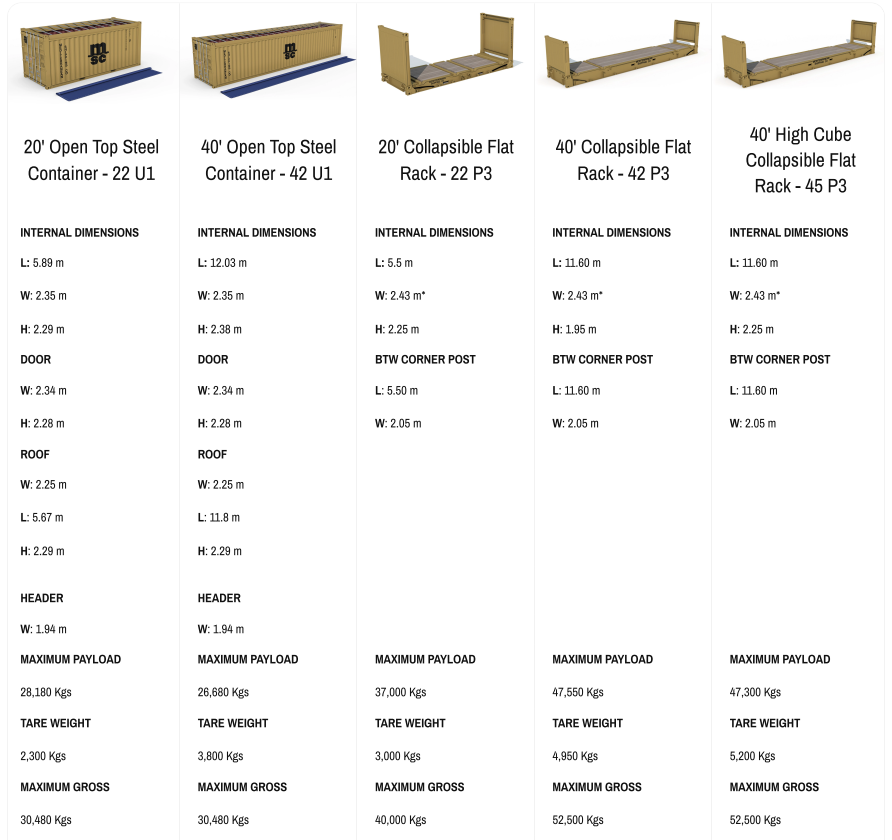
MSC-Containergröße
20-Fuß-Standard-Stahlcontainer – 22 G1
| Spezifikation | Dimension / Wert |
|---|---|
| Innenmaße | Länge: 5,9 m Breite: 2,35 m Höhe: 2,39 m |
| Türöffnung | Breite: 2,34 m Höhe: 2,28 m |
| Kubikkapazität | 33,2 m³ |
| Maximale Nutzlast | 28.260 kg |
| Leergewicht | 2.220 kg |
| Maximales Bruttogewicht | 30.480 kg |
40′ HIGH CUBE-STAHLCONTAINER – 45 G1
| Spezifikation | Dimension / Wert |
|---|---|
| Innenmaße | Länge: 12,03 m Breite: 2,35 m Höhe: 2,70 m |
| Türöffnung | Breite: 2,34 m Höhe: 2,58 m |
| Kubikkapazität | 76,4 m³ |
| Maximale Nutzlast | 28.660 kg |
| Leergewicht | 3.840 kg |
| Maximales Bruttogewicht | 32.500 kg |
3. CMA CGM-Gruppe (CMA SHIPPING)
Die CMA CGM-Gruppe ist eine der weltweit führenden Reedereien, die im Jahr 1978 in Marseille, Frankreich, gegründet wurde.
Mit einer Präsenz in 160 Ländern durch 400 Niederlassungen, 1.000 Lagerhäuser, 160.000 Mitarbeitern und einer umfangreichen Flotte von mehr als 650 Schiffen bedient CMA CGM 420 der weltweit 521 Handelshäfen und betreibt mehr als 250 Schifffahrtslinien.
CMA CGM bietet maßgeschneiderte Seefrachtlösungen an und ist bekannt für seine Nachhaltigkeitsinitiativen und sein digitales Frachtmanagement. Zur Gruppe gehören außerdem APL und CNC Line, wodurch sie ihre Präsenz auf den Strecken zwischen Asien und den USA sowie innerhalb Asiens ausbaut.
CMA-Containergröße


4. COSCO Shipping Lines
COSCO – die vollständige Bezeichnung lautet „China Ocean Shipping Company“ – hat mehr als 300 Tochtergesellschaften unter ihrem Dach.
Das Unternehmen ist einer der führenden Logistikdienstleister in China und ist mittlerweile seit fast einem Jahrzehnt im Geschäft.
Obwohl COSCO auf dem Seefrachtmarkt noch relativ neu ist, hat das Unternehmen einen Vorsprung gegenüber anderen in Asien tätigen Reedereien errungen.
Im Jahr 2012 wurde das Unternehmen unter die 15 führenden chinesischen Marken gezählt.
Derzeit ist sie die viertgrößte Containerreederei der Welt und die größte in Asien.
Als Chinas führende staatliche Reederei spielt COSCO eine entscheidende Rolle bei der „Belt and Road“-Initiative. Das Unternehmen bietet wettbewerbsfähige Tarife für Sendungen aus China und verfügt über einen guten Zugang zu Häfen in ganz Asien.
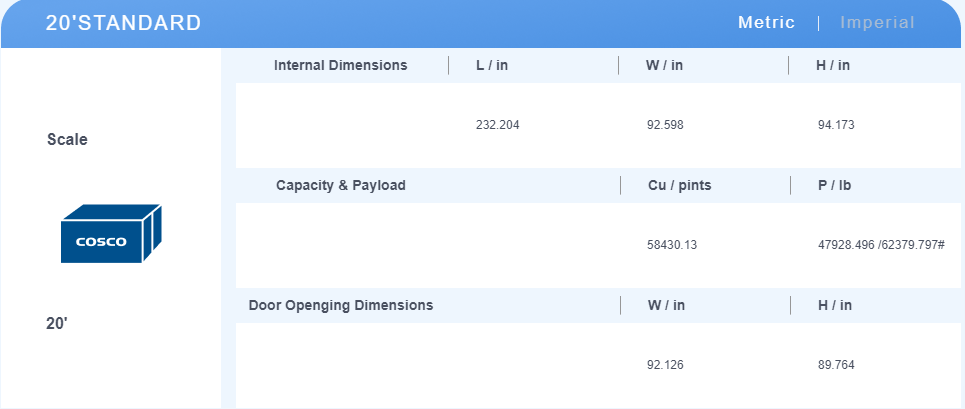
COSCO-Containergröße


5. Hapag-Lloyd (HPL SHIPPING)
Hapag-Lloyd ist eine deutsche Marke, die sich auf die Frachtbeförderung spezialisiert hat.
Das Unternehmen entstand 1970 aus dem Zusammenschluss zweier Unternehmen: der Hamburg-Amerika-Linie und des Norddeutschen Lloyd.
Derzeit ist Hapag-Lloyd gemessen an der Schiffskapazität die fünftgrößte Containerreederei der Welt.
Hapag-Lloyd genießt einen guten Ruf für seine Zuverlässigkeit und seinen Kundenservice. Das Unternehmen betreibt eine der modernsten Flotten und bietet über digitale Plattformen eine detaillierte Sendungsverfolgung.

6. ONE (Ocean Network Express) (ONE SHIPPING)
Vor der Gründung von ONE verfügten NYK, MOL und K Line jeweils über mehr als ein Jahrhundert Erfahrung im Seeverkehr. Um ihre Wettbewerbsfähigkeit zu verbessern, betriebliche Doppelungen zu reduzieren und die Effizienz zu steigern, beschlossen die drei Unternehmen, ihre Containerschifffahrtsgeschäfte unter der Marke ONE zusammenzufassen.
Das Ergebnis war ein einheitliches, leistungsstarkes und flexibles Reedereiunternehmen, das den Anforderungen der modernen globalen Logistik gerecht werden konnte.
ONE bedient über 120 Länder und Regionen, mit häufigen Abfahrten und zahlreichen Routenoptionen. Das Unternehmen ist außerdem tätig in wichtige Reederei-Allianzen, darunter DIE Allianz zusammen mit Hapag-Lloyd, Yang Ming und HMM.
ONE bietet effiziente Containerschifffahrtsdienste mit einem starken Fokus auf die Handelsrouten im asiatisch-pazifischen Raum. Dank seines einheitlichen Markenauftritts und seiner digitalen Initiativen ist das Unternehmen eine beliebte Wahl bei Exporteuren aus Japan, China und Südostasien.
7. Evergreen Marine (EMC SHIPPING)
Evergreen wurde 1968 von seinem Vorsitzenden, dem Milliardär Yung-Fa Chang, gegründet und zählt zu den zehn größten Containerschifffahrtsunternehmen der Welt.
Dieses Unternehmen hat seit seinem Einstieg in das Containerschifffahrtsgeschäft ein enormes Wachstum verzeichnet.
Derzeit verfügt Evergreen über mehr als 150 Containerschiffe, die 240 Häfen in mehr als 80 Ländern und Gebieten weltweit anlaufen.
Evergreen ist bekannt für seine Initiativen für umweltfreundlichen Seeverkehr und seine gut ausgebauten Routen zwischen Asien und den USA. Das Unternehmen hat massiv in Megaschiffe und den Betrieb von Containerterminals investiert.

8. Yang Ming Marine Transport (YML SHIPPING)
Die 1972 gegründete Yang Ming Marine Transport Corporation ist ein taiwanesisches Unternehmen mit Hauptsitz in Keelung, Taiwan.
Dieses Unternehmen blickt auf eine sehr lange Geschichte zurück, die es seiner Fusion mit der China Merchants Steam Navigation Company verdankt.
Yang Ming legt Wert auf einen effizienten Betrieb und bietet wettbewerbsfähige Frachtraten. Seine Dienstleistungen werden häufig für chinesische Exporte in Anspruch genommen.
9. ZIM Integrated Shipping Services (ZIM SHIPPING)
Hauptsitz: Israel
Flottengröße: Ca. 150 Schiffe (viele davon gechartert)
Wichtigster Vorteil: Flexible digitale Buchungsmöglichkeiten und Zusatzleistungen
ZIM hat sich mit seiner schnellen, technologieorientierten Versandkompetenz eine Nische erobert. Das Unternehmen ist eine hervorragende Wahl für zeitkritische oder spezielle Fracht.
10. PIL (Pacific International Lines) (PIL SHIPPING)
Hauptsitz: Singapur
Flottengröße: Über 90 Schiffe
Kernmärkte: Afrika, Naher Osten, Südasien
PIL ist eine der größten Reedereien mit Sitz in Südostasien. Das Unternehmen konzentriert sich auf aufstrebende Handelsrouten und bietet kostengünstige Dienstleistungen für kleine und mittelständische Unternehmen an.
Wie wählt man die richtige Containerreederei aus?
Beachten Sie bei der Auswahl eines Transportunternehmens Folgendes:
Abfahrts- und Ankunftshäfen
Transportzeit im Vergleich zu den Kosten
Zuverlässigkeit der Flugpläne
Mehrwertdienste (Tür-zu-Tür-Lieferung, Zollabfertigung, Lagerung)
Für Unternehmen, die Waren aus China versenden, kann die Zusammenarbeit mit einem Spediteur, der mit mehreren Transportunternehmen zusammenarbeitet, mehr Flexibilität und günstigere Preise bieten.
Containerschifffahrtsunternehmen spielen eine entscheidende Rolle in der globalen Lieferkette. Ganz gleich, ob Sie Vollcontainerladung (FCL), Teilladung (LCL), oder ob es sich um einen Tür-zu-Tür-Service handelt – die Wahl des richtigen Transportunternehmens kann eine pünktliche und sichere Zustellung gewährleisten.
Arbeiten Sie mit einem zuverlässigen Spediteur zusammen, um die beste Reederei für Ihre Frachtart, Ihr Ziel und Ihr Budget zu finden.
CHINA BRF LOGISTICS · PRACTICAL BOOKING GUIDE
Container Shipping Companies and Container Sizes: Plan Your Shipment from China
Choosing a shipping line is only one part of a successful shipment. Your cargo must also fit the equipment, stay within the accepted weight limits and reach a destination where unloading can be arranged. Use this practical guide alongside the carrier profiles and container specification tables on this page to compare 20ft, 40ft and 40HQ options.
BRF Logistics can help coordinate China factory pickup, warehouse consolidation, container loading, ocean freight booking and export customs clearance. Destination customs clearance and door delivery can be included when agreed for your shipment.
20ft vs 40ft vs 40HQ Container Dimensions
A 20ft container is commonly called 20GP. A standard 40ft container is 40GP, while 40HQ and 40HC both refer to a 40ft high cube container. High cube equipment provides more height; it does not automatically provide a higher permitted cargo weight.
| Equipment | Internal L × W × H | Door W × H | Nominal volume |
|---|---|---|---|
| 20GP / 20ft standard | 5.900 × 2.352 × 2.395 m | 2.340 × 2.292 m | 33,2 m³ |
| 40GP / 40ft standard | 12.032 × 2.352 × 2.395 m | 2.340 × 2.292 m | 67.7 m³ |
| 40HQ / 40HC | 12.032 × 2.350 × 2.700 m | 2.340 × 2.597 m | Approximately 76 m³ |
Sources: 20ft standard, 40ft standard und 40ft high cube. These are equipment examples, not a specification guarantee for every carrier or container.
20GP: review dense cargo
Consider 20GP for compact shipments such as bagged materials or machinery. Check total weight, floor loading and road transport limits before selecting the container.
40GP: review longer loads
Consider 40GP when cargo requires more floor space or length and standard door clearance is sufficient. Compare its actual quote with a 40HQ quote.
40HQ: review bulky cargo
Consider 40HQ for volume-driven cargo such as furniture, panels, fencing and packaged building materials. Check stackability and door height using packed dimensions.
How to Calculate CBM and Check Whether Cargo Fits
CBM = packed length × packed width × packed height in metres × quantity. Use the external dimensions of cartons, pallets or crates, including protective packaging and any overhang.
For example, 100 identical cartons measuring 1.20 × 0.60 × 0.50 m have a combined volume of 36 m³. This is above a 20GP’s nominal 33.2 m³ capacity. It may justify reviewing LCL or a larger container, but CBM alone cannot confirm the loading plan.
- Prepare a packing list with dimensions, quantities and gross weights for every package type.
- Confirm whether pallets or crates can be stacked and how much top load they can accept.
- Check the largest package against the door opening and handling clearance.
- Allow room for dunnage, lashing, irregular shapes and a practical loading sequence.
- Confirm floor load distribution, securing arrangements and equipment availability before booking.
Nominal Capacity Is Different from Usable Loading Space
A container’s published volume is a geometric reference. Pallet layout, non-stackable cargo and loading gaps reduce the space you can actually use. A package may fit the internal height but fail to pass through the lower door opening. Send BRF your packing list and cargo photos for a loading review.
When Should You Consider Special Equipment?
If packed cargo cannot pass through a dry-container door or requires top loading, review open top, flat rack or other project-cargo options. Temperature-sensitive goods may require reefer equipment. Equipment selection depends on the cargo and route; special-container dimensions, payload and charges must be confirmed separately.
How to Compare Container Shipping Companies for Your Route
The best shipping company for your shipment depends on the actual service offered between your origin and destination. A familiar brand or a low ocean rate does not, by itself, establish the best overall option. Ask for comparable quotations using the same equipment, ready date and service scope.
| Compare | Ask before booking | Why it matters |
|---|---|---|
| Routing | Is the sailing direct or transshipment? Which ports are involved? | A connection adds handling and possible schedule exposure. |
| Schedule | What are the ETD, estimated transit, cutoffs and cargo-ready requirement? | Factory readiness must match the booking and documentation deadlines. |
| Equipment | Is the requested container available and is the cargo accepted? | A rate is useful only if the shipment can actually be booked and loaded. |
| Reiseziel | Which terminal is used and what are the pickup and return arrangements? | These details affect inland transport and unloading planning. |
| Local charges | Which origin and destination charges are included or excluded? | Compare the total agreed scope rather than the ocean line item alone. |
| Free time | What free time and demurrage/detention terms apply? | Clearance and unloading delays may cause additional charges. |
Shipping Line vs Freight Forwarder
A shipping line operates or sells the ocean transport service. A freight forwarder coordinates the shipment across the agreed logistics steps, which may include pickup, warehouse handling, booking, export clearance and destination delivery. BRF Logistics helps connect those steps and compare available carrier options for the requested route.
What Determines Container Shipping Cost from China?
Container freight rates depend on the route, equipment type, cargo characteristics, sailing date and space availability. A meaningful quotation should identify its validity period, shipment assumptions and included services. Request a current quote rather than relying on a fixed price copied from an older article.
- Herkunft: factory pickup or container trucking, loading, warehouse handling, export clearance and agreed port charges.
- Ocean leg: freight and applicable surcharges for the selected sailing and equipment.
- Reiseziel: agreed terminal and handling charges, customs services and inland delivery.
- Additional items: insurance, inspections, storage, special handling and demurrage/detention where applicable.
Duties and taxes depend on the destination, product classification, origin and transaction details. A port-to-port ocean quotation should not be assumed to include import clearance, tax or home delivery.
FCL vs LCL: Which Option Should You Compare?
FCL shipping from China uses a dedicated container for your shipment. LCL shipping from China shares container space with other cargo. Compare both when cargo volume, weight or packaging makes the choice uncertain. There is no universal CBM threshold that always makes FCL cheaper; origin handling, destination charges and delivery requirements affect the result.
For cargo from several suppliers, arrange warehouse receiving and consolidation before the booking deadline. Include the final packed dimensions in the comparison so consolidation savings are not offset by unsuitable packaging or extra handling.
Explore BRF Logistics Shipping Services and Routes
Use the related guides to connect container selection with your destination and service requirements.
Ocean freight services
China export routes
Thailand export routes
Container Shipping Companies and Sizes: FAQs
Are 40HQ and 40HC the same container type?
Both abbreviations commonly mean a 40ft high cube container. Confirm the booking specifies high cube equipment and review the assigned unit’s dimensions.
How many CBM fit in a 20ft container?
A standard 20ft dry container has approximately 33 m³ of nominal internal volume. Actual usable space depends on packing, stackability, gaps and securing arrangements.
Does a 40HQ container carry more weight than a 40GP?
Not necessarily. A high cube offers more internal height, while permitted cargo weight depends on gross weight limits, tare weight, carrier acceptance and inland transport restrictions.
Which container shipping company is best for China exports?
Compare available services on your exact route using routing, sailing date, cargo acceptance, equipment, total charges and destination delivery needs. No single carrier is the best choice for every shipment.
Can I load a package that is almost as tall as the container interior?
Check the door opening first. It may be lower than the internal roof height. Also allow clearance for forklifts, packaging and safe handling.
Can BRF arrange container shipping to my warehouse or home?
BRF can review destination clearance and delivery options for the route. Provide the full delivery address, unloading arrangements and access details. Liftgate service, cranes, unloading labour and container placement require separate confirmation.
What information is required for a container freight quote?
Send origin and destination, cargo description, packed dimensions, quantities, gross weight, ready date, Incoterm, preferred container type and requested pickup or delivery services.
Request a Container Size Review and Freight Quote
Send your packing list to China BRF Logistics. Include the pickup location, destination port or delivery address, cargo-ready date and whether you need port-to-port or door delivery. We can review equipment suitability and provide available freight options for the agreed shipment scope.
Quote checklist: cargo name · package dimensions · package count · gross weight · pickup address · destination · ready date · Incoterm · unloading requirements.
Request a Shipping Quote[email protected]