The United Kingdom is home to some of the busiest and most strategically important seaports in Europe. These ports play a critical role in international trade, connecting the UK to global markets and supporting industries such as manufacturing, retail, automotive, energy, and agriculture.

This guide highlights the 10 largest ports in the United Kingdom in 2025, ranked based on cargo throughput, operational capability, and economic importance. If you are shipping goods to or from the UK, understanding these ports will help you choose the most efficient route and reduce logistics costs.

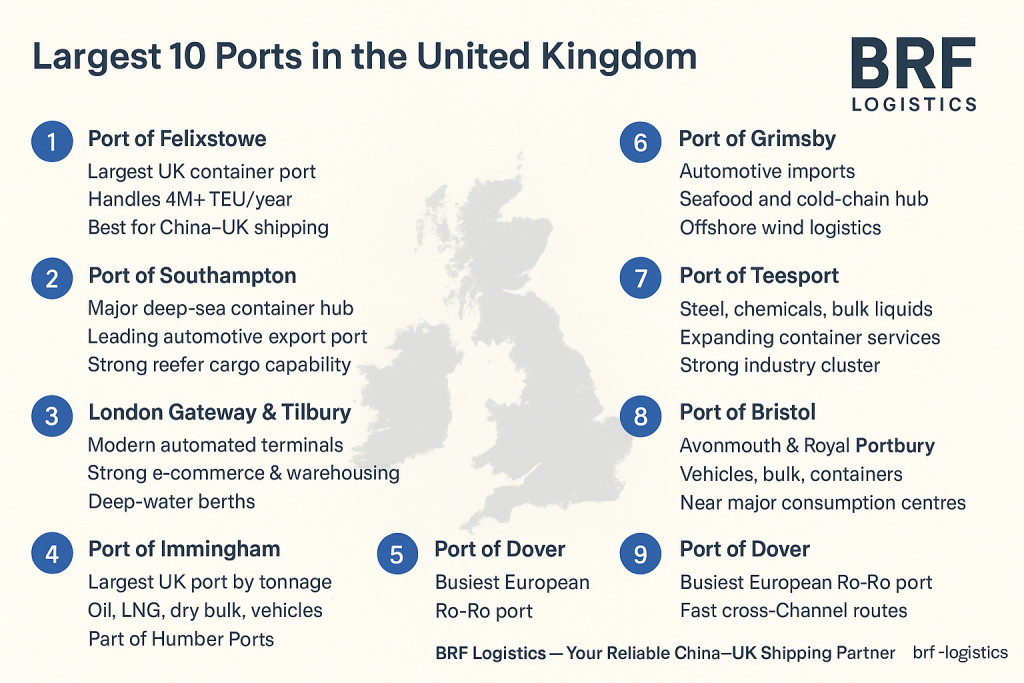
1. Port of Felixstowe

The Port of Felixstowe is the largest container port in the UK, handling over a third of the country’s total containerized cargo. Known as the “Port of Britain,” it offers:

  • Deep-water berths for ultra-large container vessels (ULCVs)

  • Advanced rail and road connectivity

  • High automation and efficient container-handling systems

Ideale per: China–UK container shipping, retail goods, electronics, industrial cargo.

2. Port of Southampton

Southampton is one of the busiest deep-sea ports in the UK and a major hub for:

  • Trasporto marittimo con container

  • Automotive exports

  • Cruise operations

It is also one of Europe’s leading ports for vehicle imports and exports.

Ideale per: Automotive, machinery, retail goods, reefer cargo.

3. Port of London (Tilbury & London Gateway)

The Port of London is a large port cluster including Tilbury Port e DP World London Gateway. Together, they form one of the UK’s major logistics hubs.

  • Tilbury specializes in bulk cargo, containers, paper, and construction materials

  • London Gateway is a state-of-the-art deep-sea container terminal with automated systems and extensive warehousing

Ideale per: E-commerce, FMCG, building materials, containers.

4. Port of Immingham (Humber Ports)

Immingham is part of the Humber Ports complex and is the largest port by tonnage in the UK. It handles:

  • Oil and petroleum

  • LNG

  • Dry bulk

  • Ro-Ro traffic

Ideale per: Energy cargo, bulk commodities, vehicles, chemicals.

5. Port of Liverpool

Liverpool serves as the main gateway for trade between the UK and North America. It features:

  • A modern deep-water container terminal (Liverpool2)

  • Excellent rail and road links to the Midlands and northern UK

Ideale per: Transatlantic trade, consumer goods, manufacturing cargo.

6. Port of Grimsby

Located on the Humber Estuary, Grimsby is the UK’s leading port for:

  • Automotive imports

  • Seafood processing

  • Offshore wind industry logistics

Ideale per: Vehicles, chilled products, renewable energy equipment.

7. Port of Teesport

Teesport is one of the UK’s most important industrial ports. It handles:

  • Bulk liquids

  • Steel

  • Petrochemicals

  • Container cargo

Ideale per: Chemicals, steel, manufacturing goods, project cargo.

8. Port of Bristol (Avonmouth & Royal Portbury)

The Port of Bristol includes two major terminals:

  • Avonmouth (bulk and containers)

  • Royal Portbury Dock (Ro-Ro, automotive, bulk cargo)

It is strategically located near major consumption centers in western and central UK.

Ideale per: Vehicles, bulk cargo, FMCG, agricultural products.

9. Port of Dover

Dover is the busiest Ro-Ro port in Europe and the primary gateway connecting the UK with continental Europe via Calais and Dunkirk.

It handles:

  • Trucks and trailers (Ro-Ro)

  • Passengers

  • High-frequency short-sea traffic

Ideale per: Fast-moving goods, cross-Channel trade, time-sensitive cargo.

10. Port of Portsmouth

Portsmouth is a key Ro-Ro and ferry port known for:

  • Vehicle transport

  • Short-sea shipping

  • Military and commercial operations

It provides regular routes to France, Spain, and the Channel Islands.

Ideale per: Ro-Ro shipments, fresh produce, retail cargo.

Why These Ports Matter for UK–China and Global Trade

The UK’s largest ports offer:

  • Shorter transit times

  • Strong intermodal networks (rail, truck, barge)

  • Advanced customs clearance systems

  • Large warehousing and cold-storage facilities

Per businesses shipping from China to the UK, selecting the right port can help reduce shipping costs, customs delays, and overall lead times.

Domande frequenti (FAQ)

1. What is the biggest port in the United Kingdom?

Il Porto di Felixstowe is the largest container port, while Immingham is the largest port by overall tonnage.

2. Which UK port is best for China–UK shipping?

Felixstowe, Southampton, and London Gateway are the top choices for China–UK container shipments.

3. Which port is the busiest for Ro-Ro traffic?

Il Port of Dover is Europe’s busiest Ro-Ro port.

4. What documents are required to ship cargo to the UK?

Key documents include:

  • Polizza di carico

  • Elenco dei colli

  • Fattura commerciale

  • Dichiarazione doganale

  • HS code information

5. How long is ocean freight from China to the UK?

Transit time typically ranges between 25–40 giorni, depending on origin port, carrier, and route.

Considerazioni finali

Choosing the right port is one of the most important decisions when planning cargo shipments to or from the UK. The ports listed above offer modern facilities, high efficiency, and reliable connections to international markets.

If you need help with sea freight, door-to-door shipping, customs clearance, or warehousing, BRF Logistics can support your shipping needs between China and the United Kingdom.

Condividi il post:

Non esitate a contattarmi in qualsiasi momento per un preventivo!

Torna all'inizio della pagina