When shipping smaller cargo volumes from China, Cargaison de groupage (LCL) is often the most cost-effective option. Whether you’re a first-time importer or an experienced buyer, understanding how LCL works can save you time, money, and headaches.
But, how does it work?
This guide will walk you through everything you need to know about Expédition en LCL from China — including how it works, key costs, timelines, pros and cons, and how to prepare your cargo.
Chapter 1:What is LCL Shipping?
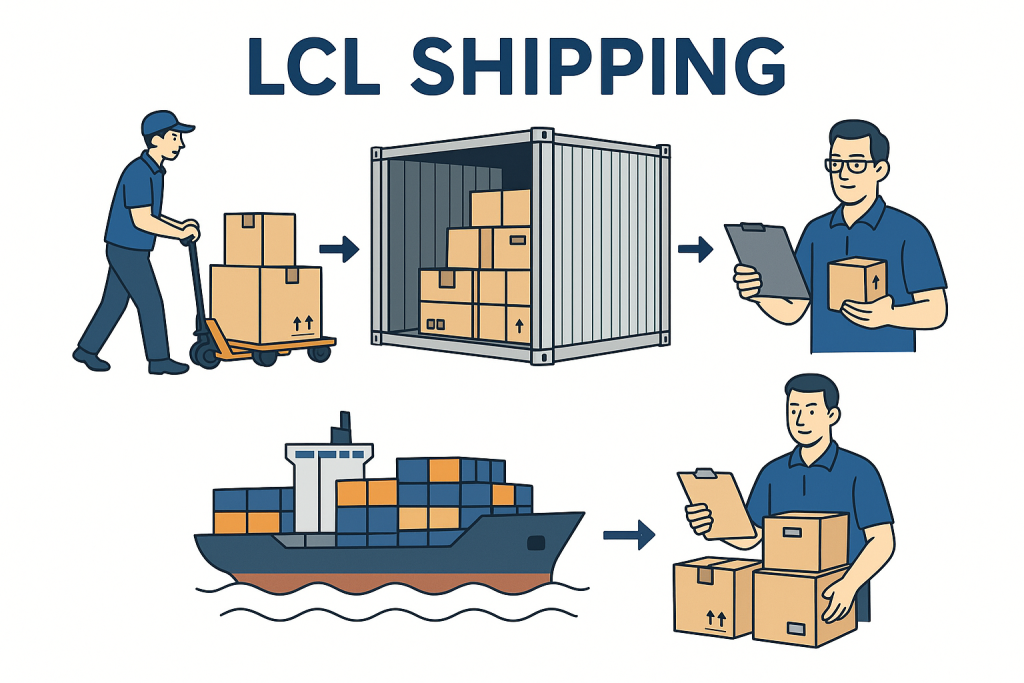
LCL (Less than Container Load) shipping means your cargo shares a container with goods from other shippers. Instead of paying for an entire 20ft or 40ft container, you only pay for the space your goods occupy.
Exemple : If your cargo is only 4 CBM (cubic meters), LCL lets you ship it affordably without waiting until you have enough goods to fill a full container.
Chapter 2: Advantages of LCL Shipping from China
There are many companies and business that use LCL shipping from China.
Of course, this is due to the benefits it comes with.
The importer is, therefore, able to expand the market reach and sell more products due to the following advantages:
(1)Cost-effective for Small Shipments
LCL (Less than Container Load) shipping is ideal when your cargo volume is less than 15 cubic meters (CBM). Instead of paying for an entire 20ft or 40ft container, you only pay for the space your cargo occupies within a shared container.
This makes LCL an affordable option for:
Small businesses and e-commerce sellers
Trial shipments or new product launches
Infrequent importers who don’t ship in bulk
With LCL, your upfront shipping costs are lower, especially when air freight is too expensive and FCL is unnecessary.
(2)Regular Weekly Departures from Major Chinese Ports
Most freight forwarders in China offer weekly LCL consolidation schedules from all major ports, including:
Shanghai
Shenzhen (Yantian, Shekou)
Ningbo
Qingdao
Xiamen
Tianjin
This means you don’t have to wait long for your cargo to be shipped. As long as you meet the cut-off date for that week’s shipment, your goods can move quickly.
For growing businesses, this regularity provides a reliable and predictable supply chain.
(3)No Need to Wait for Full Container Volume
With FCL, many shippers delay their shipments while waiting to accumulate enough stock to fill a container — often leading to storage costs and delayed delivery.
LCL solves this problem. You can ship immediately, even if your volume is only a few CBM. This allows for:
Faster inventory turnover
Lower storage costs in origin warehouses
Quicker response to market demand
By not needing full container capacity, LCL gives you the freedom to ship whenever your goods are ready.
(4)Flexible Shipping Schedules
LCL shipping is not only regular — it’s also flexible. You can:
Choose from multiple departure ports close to your factory or supplier
Select port-to-port, door-to-door, or port-to-door services
Ship mixed cargo types and quantities
Easily adjust shipment frequency based on your business needs
This flexibility is especially useful for importers dealing with seasonal demand, sample shipments, or diversified sourcing strategies.
(5)Available for Almost All Types of General Cargo
LCL shipping supports a wide variety of goods, notamment :
Consumer electronics
Clothing and textiles
Furniture and home décor
Pièces de machines
Packaged food and non-hazardous liquids
As long as the cargo is non-hazardous, properly packed, and complies with import/export regulations, it can be consolidated with other shipments.
This makes LCL a versatile option for businesses across many industries, especially for those importing from multiple suppliers in China.

Chapter 3:Challenges of LCL Shipping
After looking at the advantages of LCL shipping, you should also note that it has certain demerits.
Some of the major drawbacks of using LCL shipping from China include:
(1)Challenges of LCL Shipping
Unlike Full Container Load (FCL), LCL shipments involve multiple steps before and after the actual sea voyage. Your cargo needs to be consolidated with other shipments at the origin port, which can take several days. Once the container arrives at the destination port, the goods must be deconsolidated and sorted, adding more time before final delivery.
This entire process can extend the overall lead time by 5–7 days compared to FCL. If you’re working with tight deadlines, this delay may disrupt your supply chain.
(2)Higher risk of damage due to multiple handling
In LCL shipping, your cargo is handled more frequently than in FCL. It’s loaded into a shared container with other shipments, which may vary in size, weight, and packaging type.
Each step—warehouse consolidation, container stuffing, port handling, deconsolidation at destination—introduces risks such as:
Compression or shifting of cargo inside the container
Mishandling due to different package types
Water damage or contamination from nearby goods (e.g., chemicals, liquid products)
Proper packing and labeling are essential to minimize the chance of damage.
(3)Possible Delays If Other Cargo in the Container Has Issues
Since your shipment shares a container with others, its movement and clearance are linked to the performance and compliance of every other cargo inside.
Common issues include:
One shipper’s cargo failing customs inspection, causing the whole container to be held
Incorrect or missing documentation from another party
Dangerous goods mixed in without proper declaration
Other importers delaying container pickup or deconsolidation
Ceci lack of control can cause unpredictable delays—even if your own cargo is perfectly documented and compliant.
(4)More Complex Paperwork Compared to FCL
With LCL, documentation is more involved because it includes co-loading details and cargo separation procedures. You’ll need to coordinate closely with your freight forwarder to provide:
Accurate liste des affaires à emporter et facture commerciale
HS codes and product descriptions for proper customs classification
Export declaration forms
Detailed cargo dimensions et weights
Errors or missing details can lead to customs delays or even fines. Unlike FCL, where you have full control of the container and documentation is simpler, LCL demands more meticulous preparation and coordination.
Chapter 3:How LCL Costs Are Calculated
LCL shipping rates are usually calculated based on volume (CBM) ou weight (tons) — whichever is greater.
Basic Formula:
Freight Charge = Rate per CBM × Total Volume (or weight-based charge)
Additional Fees to Expect:
Origin charges (warehouse, handling, export docs)
Destination charges (CFS fee, customs, delivery)
Customs duties and taxes
Assurance (facultative mais recommandée)
Chapter 4:Key Ports for LCL Shipping in China
BRF offers LCL consolidation services from all major ports in China:
Shanghai
Shenzhen (Yantian, Shekou)
Guangzhou (Nansha)
Ningbo
Xiamen
Qingdao
Tianjin
These ports have weekly LCL shipping schedules to global destinations including the USA, Europe, Australia, and Southeast Asia.

Chapter 5:Tips to Save Money on LCL Shipping
Pack cargo efficiently to reduce volume
Avoid oversized or irregularly shaped packaging
Book early to secure better rates
Work with a reliable freight forwarder in China
Use proper labeling and documentation
Chapter 6:Is LCL Right for You?
Choose Expédition en LCL if:
Your cargo is under 15 CBM
You need to ship small orders regularly
You want to save costs compared to air freight
You have flexible delivery timelines
For shipments over 15–20 CBM, FCL may be more cost-effective.
Why Choose BRF for LCL Shipping from China?
À BRF Logistics, we offer:
Competitive LCL rates from all major ports
Weekly departures to 100+ global destinations
Expert export documentation support
Transparent pricing with no hidden fees
End-to-end tracking and customer service
LCL shipping from China is a practical option for small and medium-sized shipments. By understanding the process, costs, and risks, you can make smart logistics decisions that benefit your business.
Ready to ship LCL from China? Contact BRF Logistics today for a free quote.
FAQs About LCL Shipment from China
Q1: What is the minimum volume for LCL shipping?
A: Most forwarders accept as low as 1 CBM for LCL shipments.
Q2: How long does LCL shipping from China take?
A: Transit time varies from 15–40 days depending on the destination and port.
Q3: Can I ship dangerous goods via LCL?
A: It depends. Some dangerous goods are allowed but must follow strict regulations.
Q4: Do I need to clear customs myself?
A: No. Your freight forwarder or customs broker can handle this on your behalf.