China’s Unprecedented Export Controls Spark Global Trade Tensions
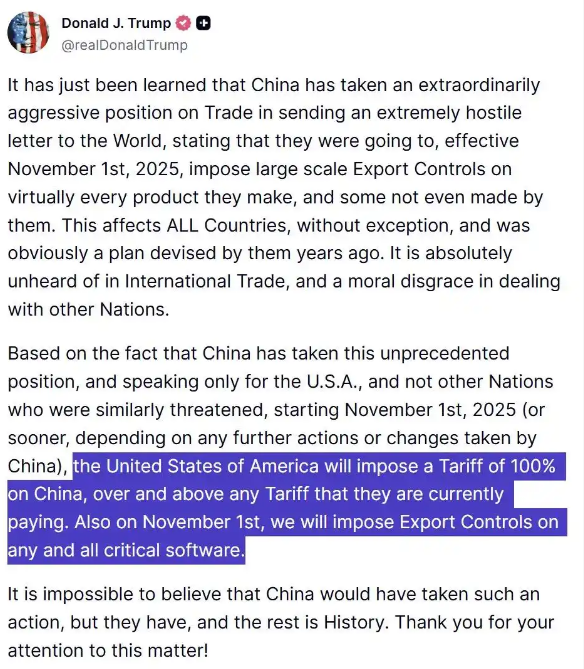
China announces sweeping export controls effective Nov 1, 2025, prompting a 100% U.S. tariff and global concern over trade disruption.
In a historic move that has shaken global markets, China has declared new large-scale export controls set to take effect on November 1, 2025. The policy, described by experts as extraordinarily aggressive, will apply to virtually every product made in China — and even some not directly produced by the nation.
This unexpected action has sparked worldwide trade anxiety and a swift diplomatic and economic response from the États-Unis.

China’s Hostile Trade Announcement
According to official statements, China has notified the global community of its intention to restrict exports to all countries without exception.
Observers say this marks one of the most radical shifts in international trade policy in modern times. The move appears to have been part of a long-term strategic plan designed to tighten China’s control over critical materials and industries.
“It is absolutely unheard of in international trade and a moral disgrace in dealing with other nations,” one U.S. official remarked.
U.S. Retaliatory Measures: 100% Tariff and Software Export Controls
In response, the United States of America has announced that it will impose a 100% tariff on all Chinese imports starting November 1, 2025, in addition to existing tariffs.
Furthermore, the U.S. will implement export restrictions on critical software and technology, aiming to protect national interests and maintain supply chain stability.
“Starting November 1st — or sooner — the U.S. will act decisively to counter China’s unprecedented trade aggression,” the statement added.
Impact on the Global Economy
Economists warn that this new trade confrontation could severely disrupt global supply chains, particularly in key industries such as:
Consumer electronics
Automotive parts and components
Semiconductor and software sectors
Agriculture and raw materials
Small and developing nations that rely heavily on Chinese exports ou U.S. technologies may face higher prices, delayed shipments, and reduced product availability.
Expert Opinions and Long-Term Outlook
Trade analysts emphasize that while export controls are not new, the scale and scope of China’s plan are unprecedented. The situation reflects rising economic nationalism and a shift toward self-reliance and regional trade blocs.
Experts also caution that if both sides remain entrenched, the world could face another global trade war, similar to or worse than the one seen in the late 2010s.
“The consequences could be long-lasting, reshaping global trade alliances for decades,” said one international economist.
Conclusion: A Turning Point for Global Ocean Freight
The simultaneous export and tariff controls represent a turning point in China–U.S. ocean freight relations.
Short-term chaos, mid-term route restructuring, and long-term diversification will redefine global logistics for years to come.
For freight forwarders and logistics providers, success will depend on route flexibility, cost management, and adaptive sourcing strategies to navigate this new era of trade uncertainty.
FAQ: China Export Controls & U.S. Tariffs 2025
Q1: When will China’s export controls take effect?
They are set to begin on November 1, 2025, covering nearly all export products.
Q2: How is the U.S. responding?
The U.S. will impose a 100% tariff increase on Chinese imports and restrict critical software exports.
Q3: What does this mean for China–U.S. shipping?
Freight volumes will drop sharply, leading to rate volatility et route adjustments by major carriers.
Q4: Will other countries be affected?
Yes. Global supply chains will face disruptions, especially nations dependent on Chinese inputs ou U.S. technologies.
Q5: What can importers and exporters do to prepare?
Diversify suppliers, secure freight contracts early, and explore alternative regional shipping routes to mitigate risks.
How the New Trade Policies Affect China–U.S. Fret maritime
1. Immediate Impact: Sharp Decline in Export Volume
Once both policies take effect on November 1, 2025, le China–U.S. trade route will experience a significant drop in shipment volume.
Exporters of electronics, machinery, and raw materials will be hit hardest.
U.S. importers may front-load shipments before the deadline, creating a short-term export surge in October followed by a sharp decline.
Chinese ports such as Shanghai, Ningbo et Shenzhen could see lower container throughput after Q4 2025.
2. Freight Rates: Short-Term Spike, Then Collapse
Before November: Freight rates may temporarily surge due to pre-tariff shipping demand.
After November: Once tariffs and export bans take effect, cargo volume will plummet, leading to rate collapse and overcapacity.
Shipping alliances (e.g., Ocean Alliance, THE Alliance) are expected to reduce sailings ou suspend routes to stabilize the market.
3. Shipping Lines and Port Strategy
Chinese ports may shift focus toward Southeast Asia, the Middle East, and Europe to offset U.S. losses.
U.S. ports like Los Angeles, Long Beach, and Oakland will handle fewer China-origin shipments but may gain volume from Vietnam, India, and Mexico.
Major carriers could realign routes toward emerging trade corridors, including Southeast Asia–U.S. et India–U.S. services.
4. Diversification de la chaîne d'approvisionnement
The new trade restrictions accelerate the “China+1” strategy, where companies diversify production outside China.
U.S. buyers will source from Vietnam, Thailand, Malaysia, and India.
Chinese exporters may use third-country transshipment hubs to reduce tariff exposure.
E-commerce and FBA sellers will face higher shipping costs and may turn to alternative logistics routes.
5. Long-Term Market Shifts
If the standoff continues, the global shipping network will be reshaped:
Southeast Asian ports (Singapore, Ho Chi Minh, Port Klang) could become new transpacific hubs.
China will expand trade with Europe, Latin America, and Africa to rebalance exports.
The U.S. may strengthen nearshoring under USMCA with Mexico and Canada, reducing dependency on Chinese manufacturing.
Articles similaires