Transporting bulk liquids internationally requires more than choosing an ocean freight rate and booking a container. The transport equipment itself can directly affect cargo safety, loading efficiency, total logistics cost, regulatory compliance, and the condition of the product when it reaches the destination.
For many international liquid shipments, two common solutions are:
ISO Tank Containers 以及 Flexitanks.
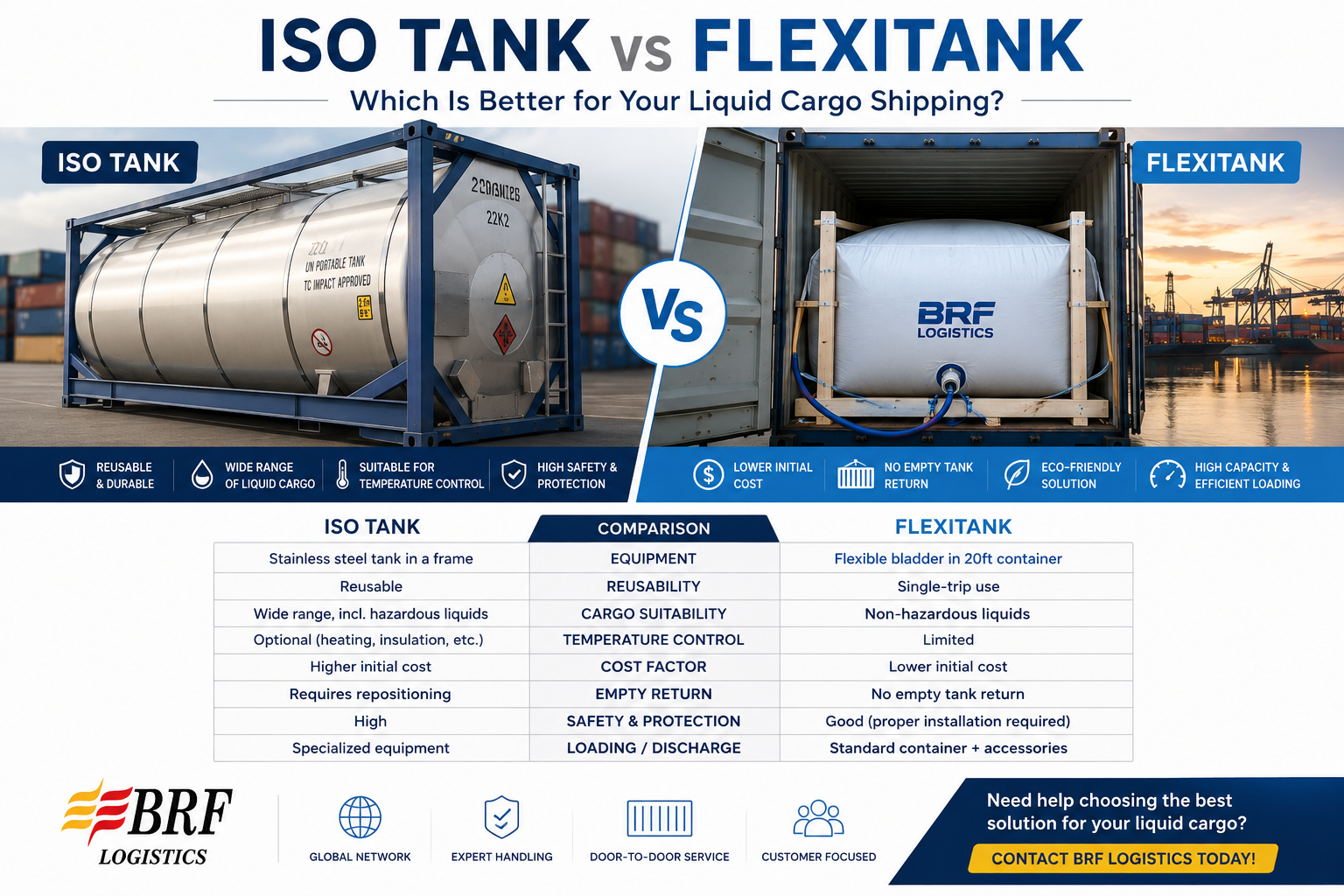
Both allow large quantities of liquid cargo to move through the international container shipping network, but they are designed for very different cargo profiles and logistics requirements.
An ISO tank is a reusable stainless-steel tank built within an ISO container frame, while a flexitank is a flexible multi-layer liquid bladder installed inside a standard 20ft dry container.
So, when comparing ISO Tank vs Flexitank, which option is better?
The answer depends on the type of liquid, cargo classification, shipment frequency, origin and destination, temperature requirements, equipment availability, and total transportation cost.
在本指南中,, BRF物流 explains the major differences between ISO tanks and flexitanks and how exporters can select the right solution for international bulk liquid shipping.
What Is an ISO Tank Container?
一个 ISO Tank Container, often called an ISO tank or tank container, is a purpose-built tank designed for the international transportation of bulk liquids.
The tank itself is normally manufactured from stainless steel and mounted within a standardized container frame.
This structure makes the unit compatible with international container handling systems, allowing it to move between:
- Container vessels
- 卡车
- Rail networks
- Container terminals
- Inland depots
without transferring the liquid cargo into another transport unit.
ISO tanks are widely used for both food-grade and industrial liquid logistics and, depending on the tank specification and applicable regulations, can also be used for certain hazardous liquids.
Major Advantages of ISO Tank Shipping
High Level of Cargo Protection
One of the primary advantages of an ISO tank is its rigid stainless-steel construction.
Unlike flexible packaging, the cargo is enclosed inside a strong tank designed specifically for bulk liquid transportation.
This provides a high level of protection against:
- Impact
- External contamination
- Leakage
- Cargo handling damage
- Environmental exposure
For high-value or sensitive products, this additional protection can be particularly important.
Suitable for a Wider Range of Liquid Cargo
ISO tanks can be configured for many different liquid products.
Applications can include:
- Food-grade liquids
- Vegetable oils
- 葡萄酒
- Juice
- Industrial oils
- Chemical liquids
- Certain hazardous liquids
- Temperature-sensitive products
However, the exact tank specification must always match the cargo classification and technical requirements.
Reusable Transportation Equipment
ISO tanks are reusable assets.
After cargo discharge, the tank can be professionally cleaned, inspected, repositioned, and used for another shipment.
For companies operating regular bulk liquid trade lanes, this reusable model can be an important operational advantage.
Heating and Specialized Tank Options
Certain products become highly viscous at lower temperatures.
Depending on the equipment specification, ISO tanks may incorporate heating or other specialized features.
This can be valuable for commodities that require controlled discharge conditions.
Examples may include some:
- Oils
- Fatty products
- Chemical materials
- Industrial liquids
Cargo temperature requirements should always be confirmed before equipment selection.
什么是柔性集装箱?
A 柔性集装箱 is a large flexible bladder that is installed inside a standard dry shipping container, normally a 20ft general-purpose container.
Once installed, the conventional dry container is temporarily converted into a bulk liquid transport unit.
The flexitank is generally manufactured from multiple layers of polyethylene film, sometimes combined with an outer protective layer.
Typical flexitank capacities vary according to design, product density, container payload, and transport requirements.
Many international flexitank shipments carry approximately 20,000–24,000 liters of compatible liquid cargo.
Unlike an ISO tank, the flexitank itself is normally intended for a single journey.
Major Advantages of Flexitank Shipping
Lower Initial Equipment Cost
One of the strongest commercial advantages of flexitanks is their relatively simple equipment model.
The shipper normally requires:
- A standard 20ft container
- The flexitank
- Protective lining
- Bulkhead equipment
- Professional installation
A dedicated reusable tank container is not required.
For many one-way shipments of compatible non-hazardous liquids, this can result in an attractive overall logistics cost.
No Empty Tank Return
After an ISO tank is discharged, the equipment remains a valuable reusable asset and normally needs to enter a cleaning, repositioning, or reuse cycle.
A standard single-trip flexitank does not create the same empty tank repositioning requirement.
After discharge, it is removed from the container and handled according to applicable local recycling or disposal procedures.
This can be particularly useful on one-way international trade lanes.
Standard Dry Container Availability
Another important advantage is that a flexitank uses a normal 20ft dry shipping container.
Standard dry containers are widely used throughout the global container shipping system.
For certain routes, this can provide greater equipment flexibility than sourcing specialized tank equipment.
Efficient Bulk Loading
Flexitanks allow liquid to be pumped directly from the shipper’s storage system into the container.
At destination, the cargo can be discharged into:
- Storage tanks
- Processing facilities
- Factory tanks
- Distribution systems
This reduces the need to handle hundreds of drums or IBCs individually.
ISO Tank vs Flexitank: Main Differences
The best way to understand the two systems is to compare their major characteristics.
| 功能 | ISO Tank | 柔性集装箱 |
|---|---|---|
| 设备 | Stainless-steel tank | Flexible multi-layer bladder |
| Typical Container Format | ISO tank frame | Installed inside 20ft dry container |
| 货物类型 | Wider liquid range | Mainly compatible non-hazardous liquids |
| Hazardous Cargo | Possible with correct approved tank | Standard flexitanks generally not for dangerous goods |
| Reusability | Reusable | Normally single-trip |
| Temperature Solutions | Available on suitable tank types | More limited and product-specific |
| Equipment Protection | Very high | Depends heavily on installation and handling |
| One-Way Shipping | Empty repositioning may be required | Often highly suitable |
| Installation | Dedicated tank equipment | Requires flexitank installation |
| 集装箱准备工作 | Tank inspection | Dry-container inspection and lining required |
The original comparison similarly emphasizes the ISO tank’s rigid reusable structure and broader cargo suitability, while presenting flexitanks primarily as a one-way solution for non-hazardous liquids.
ISO Tank vs Flexitank Cost: Which Is Cheaper?
There is no universal answer.
When comparing ISO Tank vs Flexitank cost, exporters should consider the complete transportation cycle rather than only the initial equipment price.
Why Flexitanks Can Be More Economical
For suitable cargo, a flexitank may reduce costs associated with:
- Dedicated tank rental
- Empty tank repositioning
- Cleaning of reusable tank equipment
- 鼓
- IBCs
- 托盘
- Individual package handling
This can make flexitanks particularly competitive for one-way shipments.
Why ISO Tanks Can Still Be Cost-Effective
For regular trade lanes, sensitive cargo, higher-value liquids, specialized products, or operations requiring reusable equipment, the ISO tank may provide better long-term value.
The total cost should consider:
freight + equipment + cleaning + repositioning + handling + loading + discharge + risk + destination charges.
The cheapest initial quotation is not always the lowest landed logistics cost.
Which 货物 Is Better for a Flexitank?
Flexitanks are generally best suited to compatible non-hazardous bulk liquids.
Common applications can include:
Food and Beverage Products
- 葵花籽油
- 大豆油
- Palm oil
- 橄榄油
- Fruit juice concentrate
- 糖浆
- Molasses
- 葡萄酒
- Liquid food ingredients
Industrial Liquids
Depending on product compatibility, flexitanks may also be used for:
- Base oils
- Lubricating oils
- Transformer oils
- White oils
- Certain non-hazardous industrial liquids
Before loading, exporters should review the product specification and SDS and obtain required equipment and carrier acceptance.
Which Cargo Is Better for an ISO Tank?
ISO tanks are generally more suitable when the cargo requires a higher level of equipment control.
Typical situations include:
Hazardous or Regulated Liquids
Where the cargo is classified as dangerous goods, an appropriately approved tank container may be required.
Standard flexitanks should not simply be substituted for approved hazardous-liquid transport equipment.
High-Value Liquids
When product loss would create significant financial or operational consequences, the rigid protection of a tank container may be preferred.
Temperature-Sensitive Products
Products requiring heating or other specialized temperature arrangements may be better suited to appropriately equipped tank containers.
Regular Bulk Liquid Trade Lanes
Companies shipping the same liquid continuously between established origin and destination points may benefit from a structured ISO tank logistics program.
Flexitank Installation Is Critical to Shipping Safety
A major difference between the two solutions is the importance of the dry container preparation process.
Before installing a flexitank, the container should be inspected carefully.
Operators should check for:
- 锋利的边缘
- Protruding screws
- 破损的地板
- 指甲
- Rust
- Damaged walls
- 《洞》
- 污染
- Strong odors
- Water ingress
The walls may then require protective lining, and a bulkhead or retaining system is normally installed near the doors.
Because the flexitank is flexible, professional installation and correct loading procedures are essential.
What Is the Role of the Flexitank Bulkhead?
When a flexitank is filled, thousands of liters of liquid generate substantial pressure toward the container doors.
A bulkhead system helps retain the loaded flexitank and prevents the liquid-filled bag from pushing directly against the container doors.
Depending on the system, the bulkhead may use:
- 钢筋
- Retaining structures
- Protective panels
- 表带
- 瓣膜固定组件
The flexitank manufacturer’s installation instructions should always be followed.
ISO Tank vs Flexitank for Food-Grade Liquids
Both systems can be used for appropriate food-grade liquid transportation, but they offer different logistics models.
An ISO tank may be preferred where:
- Reusable equipment is important
- High product protection is required
- Regular shipment programs exist
- Specialized discharge conditions are needed
A food-grade flexitank may be attractive where:
- The product is non-hazardous
- The shipment is one-way
- Standard 20ft container availability is important
- Packaging and repositioning costs need to be reduced
In either case, product-contact materials, previous cargo requirements, hygiene controls, cleaning requirements, and applicable food regulations must be reviewed.
ISO Tank vs Flexitank Sustainability
The sustainability comparison is more complicated than simply saying one system is environmentally better.
ISO tanks are reusable, which reduces the need to manufacture a new transport bladder for every shipment.
Flexitanks, however, can reduce the use of hundreds of drums, IBCs, pallets, and associated secondary packaging for suitable liquid cargo.
A proper comparison should therefore consider the complete logistics cycle, including:
- 包装材料
- Equipment repositioning
- Cleaning
- Recycling
- Disposal
- Payload efficiency
- Inland transport
- Empty movements
The most sustainable solution can vary by trade lane and cargo.
How to Choose Between an ISO Tank and Flexitank
Before deciding, exporters should evaluate the following factors.
1. Is the Cargo Hazardous?
If the product is classified as dangerous goods, the first priority is determining the legally approved transport equipment.
Do not choose a flexitank simply because the freight price is lower.
2. What Is the Product Density?
The liquid density affects the permissible loading volume.
A flexitank should never automatically be filled to its nominal maximum capacity without considering:
- Container payload
- Road weight limits
- Shipping requirements
- 货物密度
3. Does the Cargo Need Temperature Control?
If heating or specialized temperature management is required, the equipment needs to be evaluated accordingly.
4. Is It a One-Way or Regular Shipping Route?
Flexitanks can be particularly attractive for one-way cargo.
ISO tanks may become increasingly competitive for regular, established liquid logistics programs.
5. What Is the Total Logistics Cost?
Compare the complete supply chain.
Consider:
- 出厂装载
- Flexitank or tank equipment
- 海运
- 卡车运输
- Equipment repositioning
- Cleaning
- 海关清关
- Destination discharge
- Recycling or disposal
BRF Logistics Bulk Liquid Shipping Solutions
Choosing between an ISO Tank and Flexitank is only one step in international liquid logistics.
The complete shipment may require coordination between the supplier, equipment provider, trucking company, shipping line, customs broker, destination agent, and consignee.
BRF物流 can coordinate international liquid cargo transportation services from China, including:
- 工厂自提
- Container positioning
- Flexitank installation coordination
- Liquid loading coordination
- 海运订舱
- 出口清关
- Shipping documentation
- Destination customs coordination
- 集装箱卡车运输
- 送货上门
- Discharge coordination
For flexitank shipments, early communication is particularly important because shipping line acceptance, container condition, cargo compatibility, weight, and loading procedures should be reviewed before cargo is pumped into the container.
FAQ: ISO Tank vs Flexitank
Is a Flexitank Cheaper Than an ISO Tank?
A flexitank can have a lower initial logistics cost for certain one-way shipments of non-hazardous liquid cargo because reusable tank repositioning is not required.
However, the final decision should be based on total transportation cost rather than equipment price alone.
Can Hazardous Chemicals Be Shipped in a Flexitank?
Standard flexitanks are generally designed for compatible non-hazardous liquids.
Hazardous cargo requires transport equipment and procedures that comply with the applicable dangerous-goods regulations.
How Much Liquid Can a Flexitank Carry?
Flexitank capacities vary by design. Many international shipments use systems in the approximately 20,000–24,000-liter range.
Actual loading volume depends on product density, container payload, flexitank specifications, and transport restrictions.
Are ISO Tanks Reusable?
Yes. ISO tanks are reusable transport assets that can be cleaned, inspected, and returned to service after discharge.
What Container Is Used for a Flexitank?
A standard 20ft dry shipping container is normally used for flexitank transportation.
Is an ISO Tank Safer Than a Flexitank?
An ISO tank provides rigid stainless-steel containment and is generally suitable for a broader range of cargo and demanding transport requirements.
Flexitanks can nevertheless provide an efficient solution for suitable non-hazardous liquids when high-quality equipment, correct container preparation, professional installation, and proper loading procedures are used.
Conclusion: ISO Tank or Flexitank?
There is no universal winner in the ISO Tank vs Flexitank comparison.
一个 ISO Tank is generally the stronger option when the shipment involves hazardous cargo, high-value liquids, specialized temperature requirements, strict product protection, or regular bulk-liquid trade lanes.
A 柔性集装箱 can be an excellent option when shipping compatible non-hazardous liquids, particularly on one-way routes where lower packaging costs and the elimination of empty tank repositioning are important.
The correct decision should be based on:
cargo classification + product compatibility + volume + temperature + route + equipment availability + total landed logistics cost.
For companies exporting edible oils, juice concentrates, wine, syrups, industrial oils, and other compatible bulk liquids from China, BRF Logistics can assist with equipment coordination, loading, ocean freight, customs clearance, and international door-to-door transportation.