Sea freight from Vietnam to Australia is a practical transport option for commercial cargo that does not require urgent air delivery. Whether you are importing furniture, textiles, machinery or building materials, choosing between FCL and LCL shipping affects your freight cost, handling requirements and delivery arrangements.
A successful shipment starts with more than an ocean booking. Supplier pickup, export documentation, packaging, Australian arrival processing and final delivery all need to work together.
BRF Logistics can assess Vietnam-to-Australia ocean shipments and coordinate origin and destination services through local partners. The shipment plan is based on your supplier’s location, cargo details, Australian delivery address and required service scope.
For an overview of transport options, visit our Shipping from Vietnam to Australia route guide. To compare quotation components, read Shipping Cost from Vietnam to Australia.
Vietnam to Australia Sea Freight: Which Service Should You Choose?
The main choices are full container load shipping and less than container load shipping.
整箱运输 gives your cargo a dedicated container. 拼箱运输 allows your shipment to share container space with other cargo.
The right choice depends on the complete shipment, including cargo volume, gross weight, packaging, handling sensitivity and destination charges.
| Consideration | 整箱运输 | 拼箱运输 |
|---|---|---|
| Container use | Dedicated container for your shipment | Shared container space |
| Suitable orders | Larger shipments or cargo needing dedicated equipment | Smaller commercial orders |
| Main quotation basis | Container size, equipment and route | Chargeable volume or weight under the quoted tariff |
| Cargo handling | Usually fewer individual handling stages | Warehouse receiving, consolidation and deconsolidation |
| Packaging priority | Suitable for loading, securing and container transport | Suitable for repeated handling alongside other cargo |
| 配送计划 | Container unloading and empty return | Released cartons, pallets or crates delivered from the destination warehouse |
Compare both options where appropriate. A small shipment may work well as LCL, while a larger consolidated order may justify a dedicated container.
FCL Shipping from Vietnam to Australia
Full container load shipping is often suitable for regular import orders, bulky goods and cargo that benefits from dedicated loading space.
Common equipment options include:
- 20GP containers: often considered for compact or heavier cargo.
- 40GP containers: suitable for larger shipment volumes.
- 40HQ containers: provide additional internal height for suitable bulky cargo.
The equipment choice should follow the packing list and loading plan. A larger container does not automatically provide better value if much of its space remains unused.
What to Check Before Booking an FCL Shipment
Provide the total gross weight, package dimensions and loading requirements before requesting equipment.
Important checks include:
- Whether the cargo fits through the container doors.
- Whether packages can be stacked safely.
- How heavy items will be lifted and positioned.
- Cargo securing and weight distribution.
- Factory access for the loading vehicle.
- Container unloading facilities in Australia.
For heavy machinery or unusual cargo, photographs and drawings can help identify handling requirements before booking.
Cargo that cannot fit safely inside standard equipment may require an open-top, flat-rack or another assessed transport solution.
Factory Loading or Warehouse Loading?
A container can be loaded at the supplier’s factory where access, equipment and the agreed origin arrangement allow.
Warehouse loading may be more practical when goods come from several suppliers, the factory cannot accommodate container loading, or additional receiving and preparation are needed.
The quotation should identify where loading takes place, who provides labour and equipment, and which costs are included.
Our sea freight service page explains the broader ocean freight options available through BRF Logistics.
LCL Shipping from Vietnam to Australia
LCL shipping can suit importers whose orders do not require a full container.
Typical shipments include palletised products, spare parts, cartons of finished goods and smaller furniture or equipment orders, subject to cargo acceptance.
The cargo is received at an origin consolidation warehouse, combined with compatible shipments and transported in a shared container. After arrival, the container is unpacked at the destination facility and individual shipments are released for collection or delivery.
Why Accurate Dimensions Matter
LCL quotations depend on the final packed dimensions and gross weight.
Measure the shipment after palletising or crating. Protective packaging, pallet height and overhang can increase the chargeable volume.
Tell the forwarder if cargo is:
- Non-stackable.
- Particularly heavy.
- Fragile.
- Oversized.
- Packed in timber crates.
- Subject to special handling or cargo acceptance requirements.
These details can affect warehouse acceptance, pricing and the consolidation plan.
Packaging for LCL Transport
LCL cargo passes through more handling stages than a typical factory-loaded FCL shipment.
Packaging should protect the goods during forklift handling, warehouse storage and movement alongside other cargo. Suitable pallets, crates, edge protection and clear package markings can help reduce handling problems.
Each package should be identifiable against the packing list. Keep package counts, marks, dimensions and weights consistent across the shipment documents.
Compare Destination Charges Before Choosing LCL
An LCL ocean freight rate is only part of the total cost.
Ask whether the quotation includes origin receiving, consolidation, Australian deconsolidation, warehouse handling, clearance and delivery. Minimum charges and storage conditions also matter.
For a growing order, request an FCL comparison using the same delivery scope. There is no fixed volume threshold that makes FCL cheaper for every route.
See our Vietnam to Australia shipping cost guide for a detailed explanation of quotation components.
Main Vietnam Export Gateways
The supplier’s location helps determine which export gateway offers a practical overall routing.
Ho Chi Minh City, Cat Lai and Cai Mep
For southern Vietnam suppliers, sea freight may be assessed through Cat Lai or Cai Mep, depending on the booked service and terminal arrangements.
Compare supplier trucking distance, cargo cutoff, equipment availability and the onward ocean routing. Selecting a terminal solely by its ocean freight price can overlook additional origin costs.
Hai Phong and Lach Huyen
Northern Vietnam cargo may be assessed through Hai Phong or Lach Huyen.
The origin plan should account for supplier collection, loading or warehouse receiving, export handling and the booked terminal’s requirements.
Confirm the exact departure terminal rather than relying only on the city name shown in an initial quotation.
Da Nang and Central Vietnam
Central Vietnam shipments require a comparison of available local services and alternative routings.
Depending on the cargo and destination, the proposed movement may involve feeder connections or origin trucking to another gateway. These stages should be included in the cost and schedule comparison.
Australian Arrival Ports and Delivery Areas
The arrival port should be selected around the final destination, available ocean service and total delivery cost.
| Australian market | Ocean gateway to assess | Delivery planning considerations |
|---|---|---|
| Sydney and New South Wales | Port Botany | Warehouse postcode, truck access and unloading facilities |
| Melbourne and Victoria | 墨尔本港 | Delivery appointments, receiving hours and container handling |
| Brisbane and Queensland | 布里斯班港 | Metropolitan, Gold Coast or regional delivery requirements |
| Perth and Western Australia | 弗里曼特尔 | Local haulage, regional distance and empty container return |
| Adelaide and South Australia | Port Adelaide | Available routing and final delivery arrangements |
Provide the full Australian address when requesting door delivery.
A port-to-port quotation cannot accurately represent the cost of delivery to a regional warehouse, residential property or restricted-access project site without those details.
How Long Does Sea Freight from Vietnam to Australia Take?
Transit time depends on the named origin and destination terminals, booked service, departure date and whether the routing includes transshipment.
For delivery planning, distinguish between port-to-port transit 以及 total shipment lead time.
The complete movement can include:
- Supplier preparation and cargo collection.
- Container loading or LCL receiving.
- Export handling and departure cutoff.
- Ocean transport and any connecting service.
- Australian arrival processing.
- Customs and biosecurity release.
- LCL deconsolidation where applicable.
- Final delivery booking.
Request a proposed schedule showing the estimated departure, estimated arrival and major handling stages.
For LCL cargo, allow for consolidation before departure and deconsolidation after arrival. Vessel arrival does not mean that an individual shipment is immediately ready for delivery.
Vietnam Factory Pickup and Export Coordination
When buying from a Vietnamese supplier, confirm who handles each origin task before cargo collection.
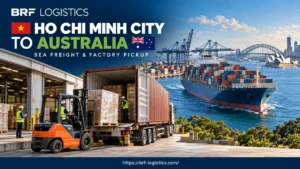
BRF Logistics can assess coordination through local partners for services such as supplier communication, pickup, warehouse receiving, container loading and export handling.
The required arrangement depends on the purchase terms and the local exporter’s responsibilities.
Information Needed from the Supplier
Obtain:
- Full factory or warehouse address.
- Cargo-ready date.
- Contact person for collection.
- Final packing list.
- Package dimensions and gross weight.
- Loading facilities and access restrictions.
- Commercial invoice.
- Export documentation responsibilities.
For multi-supplier shipments, check whether all orders can reach the consolidation point within the planned receiving window.
Documents for Vietnam to Australia Ocean Freight
Prepare the shipment documents before departure and check that the information is consistent.
Common documents include a commercial invoice, packing list and bill of lading. The export partner and Australian broker should confirm any additional requirements for the specific goods.
Descriptions should identify the actual products clearly. Avoid vague wording that makes it difficult to assess the shipment.
Australian import processing can involve product requirements and declarations needed to clear goods from customs control. Confirm the applicable requirements with the destination broker before shipment.
Packaging and Biosecurity Information
Packaging documents deserve early attention, particularly where timber packaging or other materials require assessment.
Australian biosecurity documentary requirements cover packaging materials and container cleanliness information. Delivery postcodes also help determine the suitability of unpacking locations.
Confirm the required declarations and supporting evidence before loading. If additional inspection or treatment is directed, the shipment schedule and budget may need adjustment.
Port-to-Port or Door-to-Door Sea Freight?
Port-to-port shipping may suit buyers who already have Australian customs and transport arrangements.
Door-to-door coordination can suit buyers who want the origin, international transport and delivery stages managed within one agreed scope.
For either option, clarify:
- Who acts as importer.
- Who arranges customs clearance.
- How applicable duties and taxes are handled.
- Whether inspection or treatment charges are included.
- Who provides unloading equipment.
- Storage and free-time conditions.
- Empty container return responsibilities.
The term “door-to-door” does not automatically mean that every arrival cost is included.
Read our door-to-door shipping guide and request a quotation that identifies the named delivery address and exact inclusions.
Avoiding Common FCL and LCL Shipping Problems
Booking Before the Packing List Is Final
Changes to package dimensions, weight or quantity can affect equipment selection and pricing. Use the final packed details wherever possible.
Choosing by Ocean Freight Price Alone
Compare origin, freight, arrival and delivery charges together. An apparently cheaper freight rate may come with higher local costs.
Preparing Documents Too Late
Late or inconsistent documents can interfere with export handling or arrival processing. Review the invoice, packing list and required supporting information before departure.
Overlooking Unloading Arrangements
Confirm that the receiver can accept the planned vehicle and safely unload the cargo. Identify forklift, crane or other handling needs at quotation stage.
Treating Estimated Arrival as a Guaranteed Delivery Date
Arrival, release and delivery are separate stages. Build the receiving plan around the complete movement and update it as the shipment progresses.
How BRF Logistics Can Support Your Shipment
BRF Logistics can assess the route and coordinate suitable services through origin and destination partners.
Depending on the confirmed shipment scope, this may include:
- Vietnam supplier coordination and pickup.
- FCL equipment or LCL consolidation planning.
- Loading and export handling coordination.
- Ocean freight booking.
- Shipment schedule updates.
- Australian clearance coordination.
- Port, warehouse or door delivery arrangements.
Each quotation should define the available services for your cargo, rather than assume that every shipment follows the same process.
For businesses sourcing across several countries, our 中国至澳大利亚 以及 从泰国到澳大利亚 pages provide additional origin-route information.