Sea Freight, Air Freight, Customs Clearance and Door-to-Door Delivery
Are you looking for a reliable freight forwarder for shipping from China to New Zealand?
중국 BRF 물류 provides complete sea freight, air freight, customs clearance, MPI biosecurity coordination and door-to-door delivery services from China to New Zealand.
Whether you are importing one pallet, several cubic metres of LCL cargo, one 20GP container, one 40HQ container or regular commercial shipments, our team can manage the entire transportation process.
Our China-to-New Zealand freight services include:
- 공장 직접 수령 anywhere in China
- 화물 통합 from multiple suppliers
- Warehousing in China
- Export packaging and labelling
- 컨테이너 적재 감독
- China export customs clearance
- Sea freight and air freight booking
- New Zealand customs clearance
- Import duty and GST coordination
- MPI biosecurity clearance
- ATF or transitional facility arrangements
- Container trucking and sideloader delivery
- LCL warehouse delivery
- Door-to-door delivery throughout New Zealand
- 화물 보험
- Shipment tracking and document management
From your supplier’s factory in China to your warehouse, construction site, business address or distribution centre in New Zealand, 중국 BRF 물류 provides one point of contact for the complete shipment.
Freight Forwarder from China to New Zealand
Shipping goods internationally involves much more than booking a vessel or flight.
Importers must coordinate:
- 공급업체 직접 수령
- Export customs procedures
- 해상 운송 또는 항공 운송
- Shipping documents
- New Zealand Customs requirements
- MPI biosecurity requirements
- Duty and GST payments
- Transitional facility arrangements
- Port collection
- Container delivery
- Empty-container return
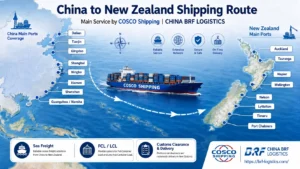
CHINA BRF LOGISTICS works with suppliers, shipping lines, airlines, customs brokers, biosecurity facilities, warehouses and local trucking companies to provide a complete transportation solution.
We offer:
- Port-to-port shipping
- Door-to-port shipping
- Port-to-door shipping
- Door-to-door shipping
- DAP shipping
- DDP shipping where operationally and legally suitable
- FCL container shipping
- LCL consolidated shipping
- 항공 화물
- Oversized cargo transportation
Sea Freight from China to New Zealand
Sea freight is normally the most cost-effective method for transporting heavy, bulky or large-volume commercial cargo from China to New Zealand.
It is commonly used for:
- 기계
- 건축 자재
- Aluminium sheets and profiles
- 알루미늄 울타리 및 대문
- 가구
- 자동차 부품
- Solar products
- 산업용 장비
- 포장재
- 플라스틱 제품
- Textiles
- Hardware
- Prefabricated structures
- 농업용 장비
- 해상 컨테이너
- 초대형 프로젝트 화물
CHINA BRF LOGISTICS can arrange both FCL 그리고 LCL sea freight from all major Chinese ports to ports throughout New Zealand.
FCL Shipping from China to New Zealand
FCL means Full Container Load. The importer books an entire container for one shipment.
Available container types include:
| 컨테이너 유형 | 적합한 화물 |
|---|---|
| 20GP | Heavy and dense cargo, metal products, machinery and tiles |
| 40GP | General commercial products and medium-volume cargo |
| 40HQ | Lightweight but high-volume goods, furniture and building materials |
| Open Top | Cargo requiring loading from the top |
| Flat Rack | Oversized machinery and project cargo |
| 냉동 컨테이너 | Temperature-controlled products |
| Tank Container | Approved liquid cargo |
FCL is usually recommended when:
- The cargo volume is large
- The shipment can fill most of a container
- Products are heavy or fragile
- The importer wants less cargo handling
- Goods from several suppliers can be consolidated
- The cargo needs better separation and security
- The importer requires container delivery to a warehouse
CHINA BRF LOGISTICS can arrange factory pickup, warehouse consolidation, container loading, customs declaration and ocean booking.
Loading photographs, container-condition photographs, seal photographs and loading reports can also be provided.
LCL Shipping from China to New Zealand
LCL means Less than Container Load. Cargo from several importers is consolidated into one container.
LCL is suitable when:
- The shipment cannot fill a full container
- Cargo volume is relatively small
- The importer wants to reduce the initial freight cost
- The shipment is not extremely urgent
- The cargo is securely packed for additional handling
LCL charges are normally calculated based on the greater of cargo volume or chargeable weight.
The LCL shipping process includes:
- Cargo pickup from the supplier
- Delivery to the consolidation warehouse
- Cargo measurement and weighing
- Export labelling
- Consolidation with other shipments
- China export customs clearance
- 해상 운송
- 목적지별 통합 해제
- New Zealand customs and MPI clearance
- Delivery of loose cargo to the consignee
Because LCL cargo requires consolidation and deconsolidation, it usually takes longer than FCL shipping.
Main Ports in China
CHINA BRF LOGISTICS can collect cargo from suppliers throughout China and select the most suitable port based on the factory location, ocean schedule and destination in New Zealand.
상하이 항구
Suitable for cargo from:
- 상하이
- 쑤저우
- Wuxi
- Kunshan
- Nantong
- Changzhou
- 난징
- Other areas of Jiangsu and Anhui
닝보항
Suitable for cargo from:
- 닝보
- 항저우
- 이우
- Shaoxing
- Taizhou
- Jinhua
- Other Zhejiang manufacturing regions
선전항
Yantian and Shekou terminals are commonly used for cargo from:
- 선전
- 둥관
- Huizhou
- Heyuan
- Eastern Guangdong
Guangzhou and Nansha Port
Suitable for suppliers in:
- 광저우
- 포산
- Zhongshan
- Jiangmen
- Zhaoqing
- Western Guangdong
칭다오항
Suitable for cargo from:
- 칭다오
- Weifang
- Linyi
- Zibo
- Jinan
- Yantai
- Rizhao
- Other Shandong cities
Tianjin Xingang
Suitable for cargo from:
- 베이징
- 톈진
- 허베이
- Shanxi
- Inner Mongolia
샤먼항
Suitable for cargo manufactured in:
- 샤먼
- Quanzhou
- Zhangzhou
- Fuzhou
- Other areas of Fujian
다롄항
Frequently used for cargo from Liaoning and other parts of Northeast China.
Main Ports in New Zealand
Selecting the correct destination port can reduce inland trucking costs, transit time and unnecessary container handling.
Port of Auckland
Auckland is New Zealand’s largest import port and one of the most important gateways for consumer goods, building products, machinery and general commercial cargo.
Auckland is usually suitable for delivery to:
- Auckland CBD
- East Tamaki
- Penrose
- Manukau
- Wiri
- Mount Wellington
- Albany
- Henderson
- Whangārei
- Hamilton
- Northern and upper North Island destinations
Cargo arriving in Auckland can be delivered by container truck, sideloader, swing-lift truck, flatbed vehicle or standard LCL delivery truck.
Port of Tauranga
The Tauranga Container Terminal is New Zealand’s largest container terminal and handles approximately 41% of the country’s shipping containers. The port has road and rail connections to Auckland, Hamilton, Waikato and the central North Island.
Tauranga is often suitable for delivery to:
- 타우랑가
- Mount Maunganui
- Rotorua
- Hamilton
- Waikato
- Bay of Plenty
- South Auckland
- Central North Island
Containers discharged in Tauranga may also be transferred by rail to MetroPort Auckland, located in Auckland’s industrial area.
Port of Lyttelton
Lyttelton is the largest port in New Zealand’s South Island and is the principal container gateway for Christchurch and Canterbury.
It is suitable for delivery to:
- Christchurch
- Rolleston
- Hornby
- Rangiora
- Ashburton
- Canterbury
- Other central South Island destinations
CentrePort Wellington
CentrePort serves Wellington and central New Zealand and provides container receiving, delivery, reefer monitoring and inland freight services.
It is suitable for:
- 웰링턴
- Lower Hutt
- Upper Hutt
- Porirua
- Palmerston North
- Manawatū
- Lower North Island destinations
Port of Napier
Napier is an important regional port for Hawke’s Bay and surrounding agricultural and industrial areas.
It can serve:
- 네이피어
- Hastings
- Hawke’s Bay
- Gisborne
- Central-eastern North Island
Port Nelson
Nelson is suitable for cargo serving:
- 넬슨
- Richmond
- Tasman
- Marlborough
- Northern South Island
Port Chalmers
Port Chalmers is the main container gateway for Dunedin and the lower South Island.
It can serve:
- Dunedin
- Otago
- Invercargill
- Southland
Port of Timaru
Timaru provides container access for South Canterbury and nearby regions. Its container terminal is connected to wider international services through New Zealand’s coastal and port networks.
Shipping Lines from China to New Zealand
The most suitable shipping line depends on:
- Port of loading in China
- New Zealand destination port
- Direct or transshipment service
- 컨테이너 유형
- 장비 가동률
- Vessel departure date
- 소요 시간
- Freight rate
- Peak-season capacity
- Free-time requirements
Shipping lines commonly considered for China-to-New Zealand container shipments include:
머스크
Maersk operates New Zealand ocean and coastal connections.
Its Northern Star service currently connects Shanghai and Hong Kong with New Zealand ports including Auckland, Nelson, Timaru, Port Chalmers, Napier and Tauranga, via Brisbane. The published rotation changed to Shanghai Yangshan in May 2026.
코스코 해운
COSCO has an established New Zealand network and participates in regular liner services calling at Auckland, Tauranga, Wellington, Napier and Lyttelton.
OOCL
OOCL works within the COSCO group network and provides services involving major New Zealand ports.
COSCO and OOCL began weekly Wellington calls in September 2025 on a service that also calls at Auckland and Tauranga.
MSC
MSC provides services to New Zealand through its Oceania and regional networks.
CentrePort Wellington reported that MSC commenced regular Wellington calls through its Noumea service in July 2025.
CMA CGM and ANL
CMA CGM and its Oceania brand ANL provide services connecting China, Southeast Asia, Australia and New Zealand.
Depending on the departure port, cargo may move through direct services or transshipment hubs such as Singapore and Australian ports.
ONE
Ocean Network Express provides booking and network coverage between East Asia and Oceania through direct and connecting services.
PIL
Pacific International Lines may be available for selected China, Southeast Asia and New Zealand routings, depending on the port and sailing schedule.
CHINA BRF LOGISTICS does not use one fixed carrier for every shipment. We compare the available carriers according to cost, transit time, equipment availability and the final delivery location.
Carrier rotations and port calls can change. The final route should always be confirmed when the booking is made.
Estimated Sea Freight Transit Time
The following figures are general planning estimates and are not guaranteed vessel schedules.
| 중국 항구 | Auckland or Tauranga | South Island Ports |
|---|---|---|
| Shenzhen / Guangzhou | 16–25 days | 20–32 days |
| 샤먼 | 17–26 days | 21–32 days |
| 닝보 | 18–27 days | 22–34 days |
| 상하이 | 18–28 days | 22–35 days |
| 칭다오 | 21–32 days | 25–38 days |
| 톈진 | 24–35 days | 28–42 days |
| 다롄 | 25–36 days | 29–43 days |
Actual transit time depends on:
- Direct or transshipment service
- Carrier rotation
- 항만 혼잡
- Weather
- 컨테이너 가용성
- Vessel schedule changes
- 세관 검사
- MPI biosecurity processing
- 목적지 항구
- LCL deconsolidation time
Door-to-door sea freight usually takes longer than port-to-port transit because it also includes factory pickup, export clearance, destination clearance and final delivery.
Air Freight from China to New Zealand
Air freight is suitable for urgent, lightweight, valuable or time-sensitive cargo.
CHINA BRF LOGISTICS can arrange air cargo from:
- Shanghai Pudong Airport
- Guangzhou Baiyun Airport
- Shenzhen Bao’an Airport
- Beijing Capital Airport
- Qingdao Jiaodong Airport
- Zhengzhou Xinzheng Airport
- Xiamen Gaoqi Airport
- 홍콩 국제공항
New Zealand’s main international air cargo gateways include:
- Auckland Airport
- Christchurch Airport
- Wellington Airport
Air New Zealand Cargo operates dedicated international cargo terminals in Auckland, Wellington and Christchurch.
Auckland is the primary international air-cargo gateway and handled approximately 89% of New Zealand’s international air cargo according to Auckland Airport’s 2025 reporting.
Air freight is commonly used for:
- 전자제품
- Replacement parts
- Samples
- 의료 기기
- 자동차 부품
- E-commerce products
- 패션 제품
- Valuable machinery parts
- Urgent production materials
Typical air-freight transit estimates are:
- Airport to airport: approximately 3–7 days
- Door to door: approximately 5–10 days
- Express courier: approximately 3–6 days
The final time depends on airline capacity, flight routing, customs clearance and MPI inspection requirements.
New Zealand Import GST
New Zealand applies a standard 15% Goods and Services Tax to imported goods.
New Zealand Customs calculates import GST based on the combined value of:
- The price paid for the goods
- 국제 화물
- 화물 보험
- Applicable import duty
New Zealand Customs generally does not collect duty or GST at the border when the shipment value is NZ$1,000 or less, although different rules can apply to goods such as alcohol and tobacco, and overseas suppliers may collect GST on low-value goods.
Import GST Calculation
The general calculation is:
GST = 15% × (Customs Value + International Freight + Insurance + Import Duty)
예를 들어:
| 원가 구성 요소 | 예시 |
|---|---|
| Customs value of goods | NZ$20,000 |
| International freight and insurance | NZ$3,000 |
| Import duty | NZ$0 |
| GST taxable value | NZ$23,000 |
| Import GST at 15% | NZ$3,450 |
This is a simplified example. Customs valuation, exchange rates, levies and product-specific charges must be checked for the actual shipment.
Import Duty and China–New Zealand FTA
Import duty depends on:
- HS code
- 제품 유형
- Material
- Manufacturing method
- 원산지
- Intended use
- Preferential tariff eligibility
- Trade-remedy measures
Some Chinese-origin products may qualify for preferential tariff treatment under the New Zealand–China Free Trade Agreement.
A New Zealand importer may claim tariff preference using:
- A certificate of origin
- A declaration of origin
- Other acceptable evidence proving that the goods comply with the relevant rules of origin
The importer must retain enough evidence to support the claim if requested by New Zealand Customs.
A zero-duty rate does not automatically mean that no import charges are payable. Import GST, Customs levies, MPI levies, port charges and brokerage fees may still apply.
New Zealand Customs Clearance
Commercial imports into New Zealand normally require coordination with New Zealand Customs and, where applicable, the Ministry for Primary Industries.
The customs-clearance process normally includes:
- Reviewing the commercial invoice
- Reviewing the packing list
- Confirming the HS code
- Confirming the customs value
- Checking the importer’s Customs Number
- Lodging the import declaration
- Assessing import duty
- Calculating 15% GST
- Paying applicable levies
- Obtaining Customs release
- Completing MPI requirements
- Arranging port collection and delivery
Goods valued at NZ$1,000 or more normally require the importer to obtain a New Zealand Customs Number. A customs broker can apply for this on the importer’s behalf.
Documents Required
일반적인 문서에는 다음이 포함됩니다:
- 상업 송장
- 포장 목록
- 선하증권
- Air waybill
- Arrival notice
- Importer Customs Number
- HS code
- Certificate of origin
- Insurance certificate
- Import permit, if required
- Treatment or fumigation certificate
- Manufacturer’s declaration
- Material Safety Data Sheet
- Dangerous-goods declaration
- Product-compliance documents
Product descriptions should be specific.
Instead of writing only “parts” or “materials,” the invoice should show information such as:
- Aluminium fence panels
- Powder-coated aluminium profiles
- Steel machinery parts
- Plastic packaging film
- 목재 가구
- Electrical control components
Accurate documents reduce clearance questions and classification disputes.
MPI Biosecurity Clearance
New Zealand has strict biosecurity controls.
MPI may check imported containers and cargo for:
- Soil
- Mud
- Seeds
- Leaves
- Insects
- Plant material
- Animal material
- Contaminated water
- Untreated wooden packaging
- Other unwanted organisms
Cargo that may receive additional attention includes:
- Wooden products
- Wooden crates and pallets
- Used machinery
- Used vehicles
- 농업용 장비
- Outdoor furniture
- Food products
- Plant and animal products
- Used shipping containers
- Natural-fibre products
Wooden packaging should comply with applicable ISPM 15 treatment and marking requirements.
Containers, machinery and cargo should be clean before departure from China. If contamination is found, MPI may require:
- 점검
- Cleaning
- Treatment
- Fumigation
- Pest identification
- Re-export
- Destruction
The importer is normally responsible for the resulting inspection, treatment, storage and transportation costs.
Does the New Zealand Warehouse Need ATF Approval for Container Delivery?
This is one of the most important questions for FCL shipments to New Zealand.
In New Zealand, the official MPI term is generally Transitional Facility, commonly referred to in the logistics industry as an approved transitional facility or ATF.
MPI states that containers arriving in New Zealand must go to a transitional facility to be packed or unpacked. The facility may be located at the port, at a third-party warehouse or at another location approved by MPI.
Can a Container Be Dropped at the Importer’s Warehouse?
A full import container generally cannot simply be delivered and unpacked at any ordinary warehouse.
The warehouse address must normally meet one of the following conditions:
Option 1: The Warehouse Is an MPI-Approved Transitional Facility
The importer’s warehouse may receive and unpack containers if it has the appropriate MPI transitional-facility approval for the relevant container and cargo type.
A transitional facility receiving containers must normally have:
- An MPI-approved facility operator
- An MPI-approved accredited person
- Appropriate operating procedures
- A suitable container-unpacking area
- Biosecurity-control procedures
- A process for reporting contamination
- MPI approval for the relevant goods
An accredited person is responsible for checking containers, supervising unpacking and controlling any biosecurity risks found during the process.
Option 2: Use a Multi-Site Transitional Facility System
For eligible low-risk sea containers, an importer may use an authorised Multi-Site Transitional Facility system.
This can allow the container to be delivered to the importer’s business without the importer operating its own permanent transitional facility.
The site must meet specified conditions, which can include:
- A suitable concrete hardstand
- Enough space around the container for inspection
- A clean and secure unpacking area
- Cargo that is not subject to a separate Import Health Standard
- Supervision and compliance through an authorised MTF provider
MPI states that the MTF system is an alternative for importers receiving low-risk sea containers who do not want their own transitional facility.
Option 3: Unpack at a Third-Party Transitional Facility
When the customer’s warehouse is not approved and the shipment is not eligible for an MTF arrangement, the container can be transferred to an approved third-party transitional facility.
The process is:
- Container is collected from the port
- Container is delivered to the approved transitional facility
- An accredited person supervises the container opening
- Cargo is unpacked
- MPI requirements are completed
- Cleared loose cargo is loaded onto a local truck
- Cargo is delivered to the customer’s warehouse
This option avoids requiring the customer to apply for its own transitional-facility approval.
Important ATF Information Required Before Shipping
Before booking a full container to New Zealand, the importer should provide:
- Complete warehouse address
- New Zealand postcode
- Contact person
- Confirmation of whether the address is an approved transitional facility
- Transitional-facility number, if available
- Type of cargo the facility is approved to receive
- Confirmation of whether an accredited person is available
- Whether the container will be live-unloaded or dropped
- Whether a sideloader can access the site
- Site opening hours
- Empty-container return arrangements
The selected facility should be nominated before the container arrives. The final delivery and unpacking instructions must follow the MPI biosecurity direction issued for the shipment.
Container Truck Delivery in New Zealand
After Customs and MPI requirements are completed, CHINA BRF LOGISTICS can arrange container transport from the destination port or transitional facility.
Sideloader or Swing-Lift Delivery
A sideloader lifts the container from the trailer and places it on the ground beside the truck.
This is suitable when:
- The customer needs time to unload
- There is enough level space
- The site can accommodate the truck
- The container can be placed close to the unloading area
- The warehouse has the necessary MPI or MTF arrangement
Live Unloading
The container remains on the trailer while the customer unloads the cargo.
This option is suitable when:
- A forklift and labour are ready
- Unloading can be completed quickly
- The site does not have space to leave the container
- The trucking company provides a suitable free unloading period
Waiting charges may apply when unloading takes longer than the agreed time.
Drop-and-Return Delivery
The container is dropped at the warehouse and collected later.
This requires:
- Sufficient space
- Suitable ground conditions
- Approval from the trucking company
- Compliance with MPI delivery requirements
- Confirmation of container free time
- A confirmed empty-container return depot
Container-Site Requirements
Before delivery, the importer should confirm:
- Is the road suitable for a heavy truck?
- Are there any narrow entrances?
- Are there low power lines or trees?
- Is the ground level and stable?
- Is there space for the truck to turn?
- Is the delivery address commercial or residential?
- Is a forklift available?
- Is a crane or Hiab required?
- Can the container be placed on the ground?
- Is the site an approved TF or eligible MTF site?
Additional charges may apply for difficult-access locations, waiting time, redelivery, rural transport, sideloader use or unsuccessful delivery.
LCL and Air-Freight Delivery
LCL and air cargo are normally delivered as loose cargo after customs and MPI clearance.
Available delivery vehicles may include:
- Courier vans
- Standard box trucks
- Tail-lift trucks
- Flatbed trucks
- Hiab crane trucks
- Refrigerated trucks
- Heavy-load vehicles
For commercial deliveries, the consignee should confirm:
- Whether a forklift is available
- Whether a loading dock is available
- Whether tail-lift service is required
- Maximum pallet weight
- Warehouse receiving hours
- Contact telephone number
- Delivery-booking requirements
Door-to-Door Shipping from China to New Zealand
Our door-to-door service can include:
- Supplier pickup in China
- Delivery to the China warehouse
- Cargo inspection and measurement
- Consolidation from multiple suppliers
- Export packaging and labelling
- China customs declaration
- Ocean or air-freight booking
- New Zealand customs clearance
- 관세 및 GST 간의 연계
- MPI clearance
- Transitional-facility arrangements
- Port collection
- Container or loose-cargo delivery
- Empty-container return
Delivery can be arranged to:
- 오클랜드
- Hamilton
- 타우랑가
- Rotorua
- 웰링턴
- Palmerston North
- 네이피어
- Hastings
- Christchurch
- 넬슨
- 티마루
- Dunedin
- Invercargill
- Other regional and rural destinations
DDP and DAP Shipping
DAP Shipping
Under a DAP arrangement, CHINA BRF LOGISTICS transports the cargo to the agreed New Zealand address.
The consignee generally remains responsible for:
- Acting as importer of record
- 수입 통관
- Import duty
- GST
- MPI charges
- Other local import costs
DDP 운송
Where legally and operationally suitable, a DDP-style service may include:
- 공장 직접 수령
- China export customs clearance
- 국제 화물
- New Zealand customs brokerage
- Import duty
- GST
- MPI processing
- Transitional-facility handling
- 최종 납품
Before accepting DDP terms, the importer-of-record structure, GST treatment, product compliance and customs responsibilities must be reviewed.
DDP is not automatically available for every commodity or consignee.
Shipping Cost from China to New Zealand
The final shipping cost depends on:
- Supplier pickup address
- Port of loading
- New Zealand destination port
- Cargo weight
- 적재 용량
- FCL or LCL
- 컨테이너 유형
- Air or sea freight
- Selected carrier
- Direct or transshipment service
- Peak-season surcharges
- Import duty
- 15% GST
- Customs and MPI levies
- Biosecurity inspection
- Transitional-facility charges
- Container trucking
- Delivery postcode
- Sideloader requirements
- Container waiting time
- Empty-container return location
Importers should compare the total landed cost rather than only the basic ocean-freight rate.
A low port-to-port rate may still involve high destination charges, inspection fees, warehouse handling or inland-delivery costs.
운임 견적에 필요한 정보
To receive an accurate quotation, please provide:
- 제품명
- Detailed cargo description
- HS 코드(해당하는 경우)
- Number of cartons or pallets
- Total gross weight
- Carton or pallet dimensions
- Total cargo volume
- Supplier pickup address
- 화물 선적 가능일
- Port of departure, if known
- New Zealand destination port
- Final delivery address and postcode
- Commercial or residential delivery
- FCL, LCL or air-freight preference
- Declared cargo value
- 인코텀스
- Packaging photographs
- Dangerous-goods information
- Import-permit information
- Confirmation of whether the warehouse is an approved TF or uses an MTF system
For full-container shipments, please also confirm whether the customer requires:
- Live unloading
- Sideloader delivery
- Container drop
- Third-party ATF unpacking
- Loose-cargo delivery after unpacking
왜 CHINA BRF LOGISTICS를 선택해야 할까요?
Complete China-to-New Zealand Service
We coordinate pickup, warehousing, customs clearance, freight, biosecurity processing and final delivery.
Coverage Across China
We can collect cargo from suppliers throughout China and route it through the most suitable port or airport.
Multiple Carrier Options
We compare different shipping lines according to schedule, price, transit time and destination-port coverage.
FCL, LCL and Air Freight
Importers can select the service that best matches their cargo volume, delivery schedule and budget.
Multiple-Supplier Consolidation
Products from several Chinese factories can be consolidated into one LCL or FCL shipment.
적재 감독
We can provide loading photographs, seal photographs and container-loading reports.
New Zealand Customs and MPI Coordination
We work with local service partners to coordinate Customs, GST, MPI and transitional-facility requirements.
Nationwide Truck Delivery
We can arrange container and loose-cargo delivery throughout the North and South Islands.
자주 묻는 질문
How long does shipping from China to New Zealand take?
Sea freight generally takes approximately 16–35 days port to port, depending on the departure port, destination port and transshipment arrangement.
Air freight usually takes approximately 3–7 days airport to airport.
What is the cheapest way to ship from China to New Zealand?
LCL sea freight is generally suitable for small shipments, while a full 40HQ container usually provides a better unit cost for high-volume cargo.
Which New Zealand port should I use?
Auckland and Tauranga are the main North Island gateways.
Lyttelton is usually suitable for Christchurch and Canterbury, while Wellington, Napier, Nelson, Timaru and Port Chalmers can serve their respective regions.
Which shipping lines operate to New Zealand?
Available carriers may include Maersk, COSCO, OOCL, MSC, CMA CGM, ANL, ONE and PIL.
The available service depends on the Chinese departure port, destination port and sailing date.
Is import GST charged in New Zealand?
Yes. New Zealand normally applies 15% GST to imported goods.
GST is generally calculated on the customs value plus international freight, insurance and applicable duty.
Do Chinese goods qualify for zero duty?
Some goods may qualify for preferential tariff treatment under the New Zealand–China Free Trade Agreement if they comply with the relevant rules of origin.
GST and other import charges may still apply.
Does my warehouse need ATF approval?
If an uncleared import container will be delivered and unpacked at the warehouse, the site normally needs to be an approved transitional facility or operate under an eligible MTF arrangement.
Otherwise, the container should be unpacked at a third-party approved transitional facility before the loose cargo is delivered.
Can the container be dropped at my warehouse?
Yes, provided that:
- MPI requirements are satisfied
- The address is approved or covered by an eligible arrangement
- The site is accessible
- The ground is suitable
- The trucking company can provide sideloader service
- Container free time and return arrangements are confirmed
Can you arrange a third-party ATF?
Yes. When the consignee’s warehouse is not approved, we can coordinate delivery to an approved transitional facility for unpacking and then arrange loose-cargo delivery.
Can you deliver containers anywhere in New Zealand?
We can arrange delivery to most commercial and regional destinations, subject to trucking availability, access conditions and MPI requirements.
Can you consolidate goods from several suppliers?
Yes. Cargo from different Chinese suppliers can be collected, checked and consolidated into one shipment.
Can you ship oversized machinery?
Yes. Open-top containers, flat racks, special equipment and breakbulk services can be arranged according to the cargo dimensions and weight.
Do you provide cargo insurance?
Yes. Cargo insurance can be arranged based on the cargo value, product type and required coverage.
Get a Quote for Shipping from China to New Zealand
Whether you need air freight, LCL shipping, a 20GP container, a 40HQ container or complete door-to-door delivery, CHINA BRF LOGISTICS can prepare a suitable transportation solution.
Please send us:
- 제품 설명
- Cargo quantity
- Weight and dimensions
- 공급업체 주소
- New Zealand destination
- Delivery postcode
- 화물 선적 가능일
- 선호하는 배송 방법
- ATF or warehouse information
CHINA BRF LOGISTICS — Your Reliable Freight Forwarder from China to New Zealand.