はじめに
Shipping chemical storage buildings internationally requires professional logistics planning, specialized equipment, and strict compliance with safety regulations. Due to their oversized dimensions, heavy weight, and potential chemical-related applications, these industrial structures require a customized transportation solution rather than standard freight services.
で BRFロジスティクス, we provide professional project cargo and oversized equipment shipping solutions, helping manufacturers, contractors, and industrial companies transport chemical storage buildings safely from China to global destinations.
Our experienced freight team manages every stage of the process, including cargo assessment, hazardous and non-hazardous identification, export documentation, loading supervision, ocean freight arrangements, customs clearance, and final delivery.
What Is a Chemical Storage Building?
A chemical storage building is a specialized industrial structure designed for the safe storage of chemicals, hazardous materials, and industrial liquids. These buildings are commonly used in manufacturing plants, laboratories, energy projects, mining operations, and chemical processing facilities.
Depending on the application, chemical storage buildings may include:
- Fire-resistant wall panels
- Spill containment systems
- Ventilation systems
- Explosion-proof electrical components
- Temperature control systems
- Safety monitoring equipment
These structures are available in different sizes, from small modular storage units to large prefabricated buildings exceeding standard container dimensions.
Because of their size and weight, chemical storage buildings are often considered oversized cargo (OOG – Out of Gauge Cargo) and require specialized freight planning.
Hazardous and Non-Hazardous Cargo Identification Before Shipping
Before arranging transportation, the first and most important step is determining whether the chemical storage building is classified as hazardous cargo or non-hazardous cargo.
で BRFロジスティクス, we perform cargo classification verification to ensure compliance with international shipping regulations.
1. Non-Hazardous Chemical Storage Buildings
Many chemical storage buildings are shipped as empty structures without chemicals inside. In this case, the building itself may be classified as general cargo.
例:
- Empty storage shelters
- 鉄骨構造
- Prefabricated storage rooms
- Modular chemical cabinets without chemical materials
Required documents may include:
- 商業送り状
- 梱包明細書
- 原産地証明書
- Material Declaration
- Non-Dangerous Goods Declaration (if required)
These shipments can usually move through standard ocean freight channels.
2. Hazardous Cargo Identification
If the chemical storage building contains chemical products, hazardous substances, batteries, fuel systems, or dangerous components, additional evaluation is required.
Cargo classification may involve:
- UN Number verification
- IMO Dangerous Goods classification
- Hazard class identification
- Packing group confirmation
- Safety Data Sheet (SDS/MSDS) review
Common IMO dangerous goods classes include:
- Class 3: Flammable liquids
- Class 4: Flammable solids
- Class 5: Oxidizing substances
- Class 6: Toxic substances
- Class 8: Corrosive materials
- Class 9: Miscellaneous dangerous goods
BRF Logistics works with customers to confirm the correct classification before shipment to avoid customs delays, port rejection, or compliance issues.
Transportation Methods for Chemical Storage Buildings
Choosing the correct transportation method depends on:
- Overall dimensions
- 総重量
- 読み込み要件
- Destination regulations
- Budget considerations
Flat Rack Container Shipping
Flat Rack containers are commonly used for oversized chemical storage buildings that exceed standard container dimensions.
メリット:
- Suitable for wide cargo
- Easy crane loading
- Strong structure for heavy equipment
- Ideal for project cargo transportation
Open Top Container Shipping
Open Top containers provide additional height clearance for tall structures.
They are suitable for:
- Buildings with excessive height
- Cargo requiring top loading
- Heavy equipment requiring crane handling
Standard FCLコンテナ輸送
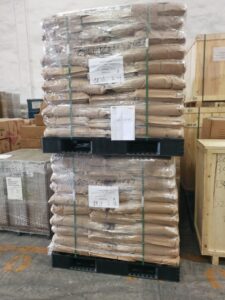
For modular chemical storage buildings that can be disassembled, FCL shipping is often the most economical solution.
Common options:
- 20GP container
- 40GP container
- 40HQコンテナ
Disassembled panels and components can be packed efficiently to reduce transportation costs.
バラ積み輸送
For extremely large chemical storage buildings that cannot fit into containers, break bulk transportation may be required.
This method involves:
- Direct vessel loading
- Heavy lifting equipment
- Port crane operation
- Professional project cargo management
Loading Process for Chemical Storage Buildings
Safe loading requires detailed preparation.
Step 1: Cargo Inspection and Planning
Before loading:
- Confirm cargo dimensions
- Check weight distribution
- Review lifting points
- Prepare loading plans
Step 2: Professional Lifting Equipment
Depending on cargo weight, loading may require:
- Mobile cranes
- Heavy-duty forklifts
- Steel lifting slings
- Spread bars
- Hydraulic lifting systems
Step 3: Cargo Securing
After loading, the structure must be properly secured using:
- Steel chains
- Heavy-duty straps
- Blocking materials
- Anti-slip protection
Proper securing prevents movement, vibration damage, and structural deformation during transportation.
International Shipping Documentation Requirements
BRF Logistics assists customers with complete documentation preparation:
- 商業送り状
- 梱包明細書
- 船荷証券
- 原産地証明書
- SDS/MSDS
- Dangerous Goods Declaration (if applicable)
- Export customs documents
- Import clearance documents
なぜ選ぶのか BRFロジスティクス?
With experience in industrial equipment transportation, BRF Logistics provides:
✔ Oversized cargo solutions
✔ Hazardous cargo assessment
✔ Ocean freight management
✔ FCL, FR, OT, and Break Bulk shipping
✔ Global customs support
✔ Door-to-door delivery solutions
From factory pickup to final installation site, we coordinate every step to ensure safe and reliable transportation.
よくある質問
Can chemical storage buildings be shipped in standard containers?
Yes. If the structure can be dismantled into smaller modules, it can usually be shipped in 40HQ containers. Larger assembled units require Flat Rack, Open Top, or Break Bulk solutions.
Do chemical storage buildings require dangerous goods shipping?
Not always. Empty chemical storage buildings are usually classified as non-dangerous cargo. However, units containing chemicals or hazardous materials require IMO classification and proper documentation.
What information is needed for a shipping quotation?
Customers should provide:
- 寸法
- 重量
- Loading location
- 仕向地港
- Photos
- Drawings
- SDS documents if chemicals are included
結論
Shipping chemical storage buildings requires specialized logistics knowledge, accurate cargo classification, and professional project management.
BRF Logistics provides complete transportation solutions for oversized industrial structures, helping customers safely ship chemical storage buildings worldwide while meeting international safety and compliance requirements.