In the fast-moving world of ocean freight and global logistics, knowing the major port hubs can give you valuable insight into trade flows, capacity bottlenecks and strategic routing opportunities. Based on the latest available data from 2024/2025, here are the ten largest container ports by throughput and their significance for global shipping.
Below is the list of the top ten busiest container ports in the world, according to recent reports.
| Rank | 항구 | 국가 | Approx. Throughput / Notes |
|---|---|---|---|
| 1 | 상하이 항구 | 중국 | Around 51.5 million TEUs in 2024. |
| 2 | Port of Singapore | 싱가포르 | About 41.1 million TEUs in 2024. |
| 3 | Port of Ningbo‑Zhoushan | 중국 | Growth of ~11% in 2024; approx 39.3 million TEUs. |
| 4 | 선전항 | 중국 | Vital gateway for southern China’s exports. |
| 5 | 칭다오항 | 중국 | Among the top five; major bulk and container flows. |
| 6 | 광저우항 | 중국 | A major southern China port in the top-ten. |
| 7 | Port of Busan | South Korea | The largest in Korea and key trans-Pacific node. |
| 8 | 톈진항 | 중국 | Northern Chinese port serving Beijing-region trade. |
| 9 | Port of Jebel Ali (Dubai) | United Arab Emirates | The Middle-East’s largest container hub; ranks around 9. |
| 10 | Port Klang | 말레이시아 | Emerging strong contender for top-10 position. |
How to Choose the Best Port for Your China-Australia Shipment
-
Eastern China factories → Shanghai / Ningbo
-
South China electronics → Shenzhen / Guangzhou
-
Flexible routing & lower risk → Singapore transshipment
-
Urgent / high-value cargo → Busan
1. Port of Shanghai, China
Throughput (2024): 51.5 million TEUs
The Port of Shanghai remains the world’s busiest container port, holding this title since 2010. Located at the mouth of the Yangtze River, it connects China’s manufacturing heartland to over 500 ports in 200 countries.
Shanghai’s Yangshan Deep-Water Port handles mega-container vessels up to 24,000 TEUs and boasts world-leading automation systems. For shippers exporting from eastern 중국에서 호주로, Europe, or North America, Shanghai is an essential gateway due to its efficiency, large capacity, and strategic geographic location.
2. Port of Singapore, Singapore
Throughput (2024): 41.1 million TEUs
Singapore consistently ranks as the top global transshipment hub, linking Asia, Oceania, the Middle East, and Europe. It handles around 20% of the world’s container transshipments annually.
The new Tuas Mega Port, once fully completed by 2040, will handle up to 65 million TEUs, making Singapore an even more critical hub for China-Australia shipping routes. Singapore’s efficiency, depth, and reliability make it a preferred stopover for major carriers like Maersk, MSC, and COSCO.
3. Port of Ningbo-Zhoushan, China
Throughput (2024): 39.3 million TEUs
Located south of Shanghai, Ningbo-Zhoushan Port continues to rise as a global maritime powerhouse. It serves as a major export base for Zhejiang Province, handling both containers and bulk cargo.
Ningbo’s expansion projects — including the Meishan Terminal and upgraded logistics zones — are boosting its intermodal capabilities. For exporters shipping from factories in Zhejiang, Jiangsu, or Anhui, Ningbo provides a highly efficient alternative to Shanghai with shorter inland transport routes.
4. Port of Shenzhen, China
Throughput (2024): ~33 million TEUs
Comprising terminals like Yantian, Shekou, and Chiwan, the Port of Shenzhen handles a massive portion of China’s southern exports, particularly electronics and consumer goods.
Shenzhen’s proximity to 홍콩 그리고 Pearl River Delta manufacturing zone makes it an indispensable part of the China-Australia trade lane. It is also among the most technologically advanced ports in China, integrating AI-driven scheduling and automated stacking cranes.
5. Port of Qingdao, China
Throughput (2024): ~27 million TEUs
Qingdao, a key northern port in Shandong Province, plays a dual role — container shipping and bulk commodities like oil and iron ore. Its fully automated terminal, launched in 2017, remains one of the most efficient in Asia.
For exporters from North China, Qingdao offers direct sea freight connections to Melbourne, Sydney, and Brisbane, making it an ideal port for China-Australia ocean freight.
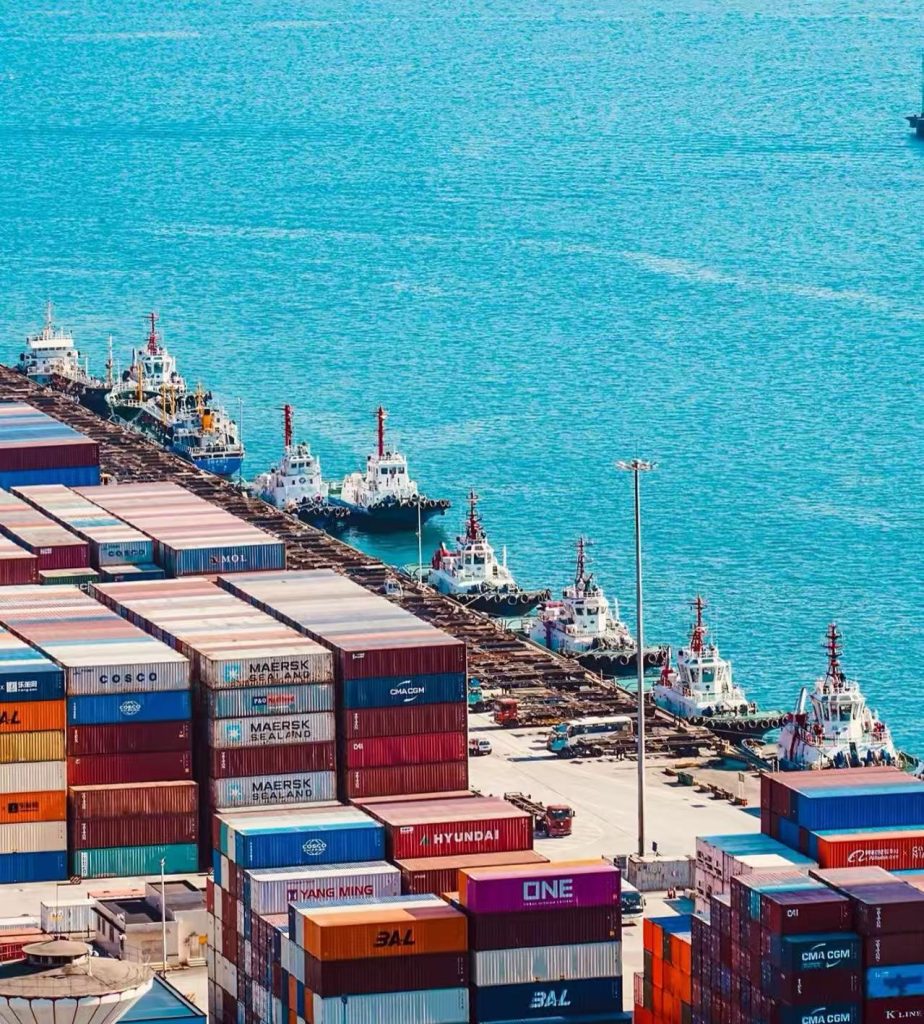
6. Port of Guangzhou, China
Throughput (2024): ~26 million TEUs
Guangzhou Port (Nansha Port Area) serves the Pearl River Delta Economic Zone, supporting exports from Guangdong’s manufacturing base. The port connects directly to global trade lanes through the South China Sea.
With increasing container automation and railway integration, Guangzhou is strengthening its role as a multi-modal logistics hub, complementing nearby Shenzhen.
7. Port of Busan, South Korea
Throughput (2024): ~23 million TEUs
Busan remains the largest port in South Korea and a vital transshipment hub for Northeast Asia. Its deep-water facilities serve major carriers on Asia-Europe and Asia-Oceania routes.
The ongoing Busan New Port expansion will raise its annual capacity beyond 25 million TEUs, reinforcing its position among the world’s top 10 ports. Many China-Australia sea freight shipments are transshipped via Busan due to its efficiency and strategic proximity.
8. Port of Tianjin, China
Throughput (2024): ~21 million TEUs
Serving as the maritime gateway to Beijing and Northern China, Tianjin handles containerized cargo, bulk, and Ro-Ro shipments. It has robust rail connections to inland China, making it a crucial node for both domestic and international trade.
Tianjin also plays a role in the Belt and Road Initiative, linking China to Central Asia and Europe through sea-rail intermodal transport.
9. Port of Jebel Ali, Dubai, UAE
Throughput (2024): ~14 million TEUs
Jebel Ali is the largest port in the Middle East, located strategically between Asia and Europe. Operated by DP World, it serves as a major transshipment hub for cargo heading to Africa, India, and Australia.
Its world-class logistics facilities make it a key connector for China-Middle East-Australia trade routes, especially for high-value and project cargo shipments.
10. Port Klang, Malaysia
Throughput (2024): ~13.5 million TEUs
Port Klang has grown steadily due to Malaysia’s strong role in regional manufacturing and re-export trade. Located near Kuala Lumpur, it offers excellent connections for carriers operating along the Asia-Oceania trade lane.
Port Klang’s expansion and modernization projects aim to raise its handling capacity beyond 15 million TEUs by 2026, solidifying its place in the global top 10.
Global Container Port Trends in 2025
1. Asia’s Continued Dominance
Seven out of the ten largest ports are in China, highlighting the country’s unrivaled role in global manufacturing and export logistics. Together, Asian ports handle over 70% of global container traffic.
2. Automation & Smart Ports
From Shanghai to Singapore, ports are embracing AI, 5G connectivity, and autonomous equipment to boost efficiency and reduce carbon footprints.
3. Green Shipping Initiatives
Environmental regulations are pushing ports to adopt shore power systems, LNG bunkering, 그리고 eco-friendly operations to cut emissions from vessels and terminals.
4. Supply Chain Diversification
Geopolitical shifts and trade tensions are driving companies to diversify production and shipping routes — giving rise to emerging hubs like Port Klang 그리고 Laem Chabang (Thailand).
Why These Ports Matter for China-Australia Shipping
For businesses shipping goods from China to Australia, understanding the major global ports is key to planning efficient and cost-effective routes.
Ports such as Shanghai, Ningbo, and Shenzhen directly serve major Australian destinations (Sydney, Melbourne, Brisbane).
Singapore and Busan act as vital transshipment hubs, ensuring flexible routing options and faster delivery times.
Knowing seasonal congestion at these mega-ports helps avoid delays and optimize logistics planning.
자주 묻는 질문
Q1: Which is the largest port in the world in 2025?
The Port of 중국 상하이, remains the largest, handling over 51 million TEUs in 2024.
Q2: What is the busiest transshipment port?
싱가포르 is the world’s busiest transshipment hub, managing about one-fifth of global container transfers.
Q3: How many of the world’s top 10 ports are in China?
Seven of the top 10 container ports are located in China, reflecting its massive export volume and industrial base.
Q4: Which port is best for shipping from China to Australia?
Shanghai, Ningbo, and Shenzhen offer the most direct services, while Singapore provides flexible transshipment options.
Q5: Are container ports getting more congested in 2025?
Yes. Diversion from Red Sea routes and peak-season demand have increased pressure on major Asian hubs.
Q6: What is the difference between gateway ports and transshipment ports?
Gateway ports serve domestic exports, while transshipment ports redistribute cargo globally.