The global container shipping market is entering a period of severe turbulence. According to recent industry data, ocean freight profit margins have collapsed by more than 53%, driven by weak demand, high operating costs, and escalating tariff uncertainties. After two years of unprecedented growth during the post-pandemic shipping boom, the industry now faces a potential “winter” that could reshape global logistics patterns.
In this article, we break down the key causes behind the profit plunge, analyze regional impacts, and assess what shippers and freight forwarders should expect in the coming months.
Why Are Ocean Freight Profits Falling Sharply?
1. Demand Decline Across Major Trade Lanes
After a period of strong consumer spending from 2021–2023, global demand for manufactured goods has significantly weakened.
Retailers in the US and Europe are overstocked
Inflation continues to squeeze consumer spending
Many importers have shifted to cautious procurement strategies
This has led to softer bookings, lower cargo volume, and reduced revenue for carriers.
2. Tariff Pressures and Geopolitical Risks
New and proposed tariff measures—particularly between the US, EU, and China—are increasing uncertainty across the supply chain.
Key concerns include:
Higher import fees on Chinese goods
Possible tariff escalation during political cycles
Diversion of trade routes to Southeast Asia and India
These disruptions are forcing carriers to constantly adjust capacity, often operating ships below optimal utilization levels.
3. Capacity Oversupply After the Pandemic Boom
During the pandemic freight surge, carriers placed massive orders for new vessels. These ships—especially LNG-powered mega-vessels—are now being delivered just as demand drops.
This results in:
Excess capacity
Lower freight rates
Fierce price competition among carriers
The oversupply problem may last through 2025–2026, putting long-term pressure on earnings.
4. Soaring Operational Costs
Operational costs remain elevated:
Marine fuel (VLSFO & LNG) prices
Crew salaries and safety compliance
Port congestion in key hubs like Singapore, LA/LB, Rotterdam
Even as freight rates fall, carriers cannot reduce these fixed overheads.
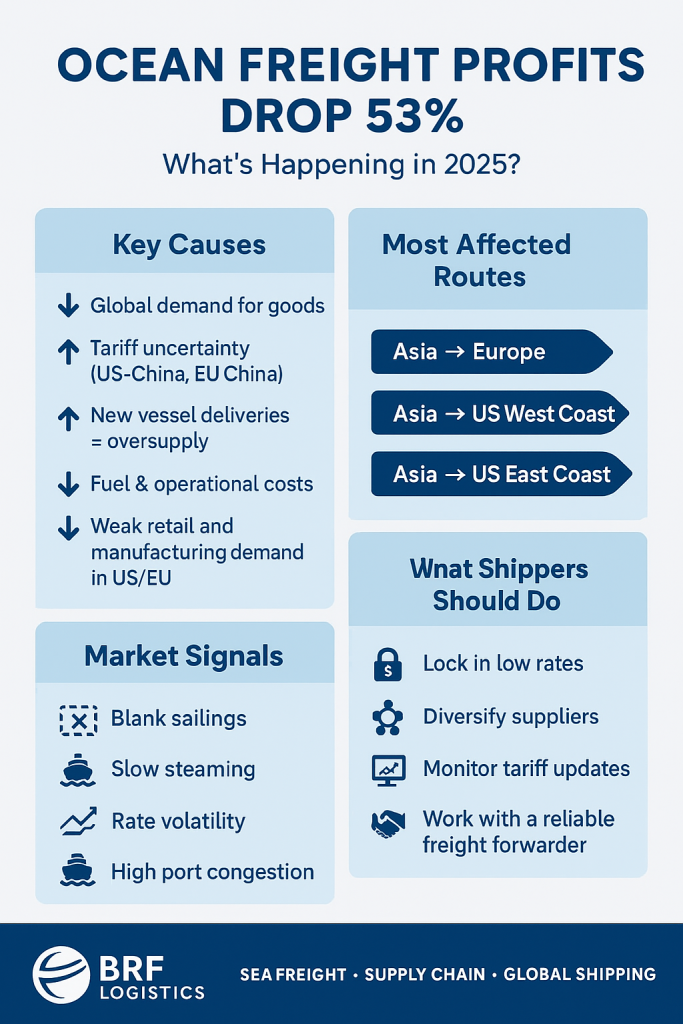
How Are Different Regions Affected?
北米
Import volume remains below pre-pandemic levels.
The US–China tariff climate continues to discourage high-volume orders from American retailers.
ヨーロッパ
Weak economic growth, high energy prices, and slow manufacturing output have kept container demand fragile.
Europe–Asia trade routes remain the most heavily affected.
Asia-Pacific
China’s export slowdown and cautious factory production have reduced outbound volumes.
However, Southeast Asian routes show moderate resilience as supply chains diversify.
Will the Container Shipping Industry Enter a “Winter”?
Many analysts believe a prolonged downturn is possible.
Key warning signs include:
Carriers reducing sailings (blank sailings)
Alliances optimizing or cancelling services
Rate volatility on major lanes
Increased slow steaming to reduce fuel consumption
However, the industry is not without opportunities. Carriers with strong cash reserves and diversified logistics services (such as warehousing, e-commerce fulfillment, and last-mile delivery) may still perform steadily.
What Should Importers and Exporters Do Now?
1. Lock in Favorable Freight Rates
With rates dropping, this is a good time to negotiate long-term contracts.
2. Diversify Routing & Carriers
Avoid over-reliance on one carrier or trade lane. Multiroute strategies reduce risk.
3. Monitor Tariff Announcements Closely
Tariff changes can impact landed cost and sourcing strategy overnight.
Shippers should stay updated on US/EU policies for 2025.
4. Work with a Reliable Freight Forwarder
Forwarders with strong carrier relationships can secure space, manage customs risks, and optimize shipping costs—especially during volatile periods.

Conclusion: A Challenging But Transformative Period Ahead
The 53% drop in ocean freight profits signals a major shift in the global container shipping industry. While the short-term outlook shows signs of a “shipping winter,” the long-term transformation may bring opportunities in supply chain restructuring, digitalization, and multi-country sourcing.
Businesses that stay proactive—monitoring tariffs, optimizing routes, and partnering with reliable logistics providers—will be best positioned to navigate this new era in global trade.
FAQ: Ocean Freight Profits Drop 53% — What Shippers Need to Know
1. Why did global ocean freight profits fall by 53%?
Profits plunged mainly due to weaker global demand, excess vessel capacity, and rising tariff uncertainties. Many carriers are operating ships below optimal utilization, which directly reduces earnings.
2. Are freight rates expected to continue dropping?
Yes, in the short term. Oversupply of new vessels and soft demand are likely to keep rates under pressure through 2025. However, geopolitical tension or port congestion may cause temporary rate spikes.
3. How will US–China and EU–China tariffs affect shipping?
Tariffs increase import costs and reduce purchase volume from China, weakening container demand. They also cause trade route shifts to Southeast Asia, forcing carriers to adjust capacity frequently.
4. What trade lanes are most affected by the downturn?
Asia–Europe and Asia–US West Coast routes are experiencing the sharpest declines, driven by inflation, slow manufacturing output, and overstocked inventories.
5. Will carriers reduce sailings or cancel services?
Yes. Many shipping alliances have begun blank sailings, slow steaming, and reduced weekly services to control capacity and stabilize freight rates.
6. How long will the “shipping winter” last?
Analysts predict the downturn may last until late 2025 or even 2026 due to oversupply of vessels. The recovery depends on global consumption, manufacturing output, and tariff policy changes.
7. What can importers and exporters do to minimize risk?
Lock in favorable long-term contracts
Diversify suppliers beyond a single region
Monitor tariff announcements
Work with a reliable freight forwarder to optimize space and routing
8. Is this downturn similar to the 2016 shipping crisis?
The situation is similar in terms of oversupply and low demand, but carriers are financially stronger today. Consolidation and alliances will help prevent a collapse like Hanjin’s.
9. Will freight forwarders benefit from this environment?
Yes. With rates fluctuating and capacity shifting, shippers rely more on forwarders for space booking, customs clearance, risk management, and cost optimization.