When shipping cargo to certain African countries, exporters and importers may come across a document or reference number called CTN.
For companies that are familiar with standard international shipping documents, CTN can sometimes be confusing. Is it a container number? Is it related to the number of cartons? Is it the same as a Bill of Lading number?
Tidak.
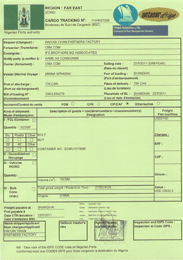
CTN generally stands for Cargo Tracking Note. It is a regulatory shipping document or reference number used by certain African countries to collect advance information about cargo entering or transiting through their ports.
Depending on the destination country, the system may also be called ECTN (Electronic Cargo Tracking Note), ICTN (International Cargo Tracking Note), or another country-specific name.
This article explains what CTN means, how it works, when it may be required, and why exporters should arrange it before shipping.
What Does CTN Mean in Shipping?
CTN stands for Cargo Tracking Note.
A CTN is a cargo-monitoring and documentation requirement implemented by certain African countries. Its purpose is to provide the destination country’s authorities with advance information about an international shipment.
The information associated with a CTN may include:
- Shipper information
- Consignee information
- Pihak yang diberitahu
- Port of loading
- Port of discharge
- Vessel information
- Bill of Lading details
- Container information
- Deskripsi muatan
- Kode HS
- Cargo quantity
- Berat kotor
- Commercial invoice value
- Freight information
- Negara asal
- Other shipment-related information
The exact requirements vary from one country to another.
For example, Nigeria’s maritime regulatory framework includes the implementation of an International Cargo Tracking Note (ICTN) under the Nigerian Shippers’ Council.
Therefore, CTN should be regarded as a country-specific regulatory compliance document, rather than a standard international shipping document required for every shipment worldwide.
Is CTN the Same as a Container Number?
No. This is one of the most common misunderstandings.
A Container Number identifies a physical shipping container.
Misalnya:
MSCU1234567
This is a container identification number.
By contrast, a CTN Number is a regulatory reference associated with the cargo shipment and the applicable cargo-tracking system.
Misalnya:
CTN No.: NG-XXXX-XXXXXX
The actual format depends on the country and issuing system.
Container Number vs. CTN Number
| Barang | Container Number | CTN Number |
|---|---|---|
| What is it? | Physical container identification | Cargo tracking/compliance reference |
| Identifies | A specific container | A shipment/cargo record |
| Issued by | Container owner/carrier | Applicable CTN authority/authorized system |
| Contoh | MSCU1234567 | Country-specific CTN reference |
| Used for | Container tracking | Regulatory cargo tracking |
| Is it the same as carton quantity? | Tidak | Tidak |
So if a customer asks for a CTN Number, they are generally not asking for the number of cartons, packages, or containers.
Is CTN the Same as the Number of Cartons?
Tidak.
For example, suppose a shipment contains:
- 1 buah kontainer 40HQ
- 500 cartons
- 8,000 KG
- 20 CBM
The packing list may show:
Total Quantity: 500 Cartons
The Bill of Lading may show:
1 × 40HQ
The container number could be:
ABCD1234567
And the CTN would be a separate regulatory reference number.
These four pieces of information serve different purposes.
Contoh
A shipment from China to Nigeria could have:
Kontainer:
1 × 40HQ
Container No.:
MSCU1234567
Kargo:
500 Cartons
Bill of Lading No.:
ABCD123456789
CTN No.:
Country/system-specific reference number
Therefore, CTN should never be interpreted simply as “the number of boxes.”
Why Do Some African Countries Require CTN?
The main purpose of CTN systems is to provide destination authorities with advance cargo information.
International shipments can contain a large amount of information involving:
- Exporters
- Importers
- Shipping lines
- Freight forwarders
- Customs authorities
- Ports
- Government agencies
- Cargo inspection organizations
A cargo tracking system allows authorities to obtain shipment information before the cargo arrives.
The Nigerian Shippers’ Council, for example, identifies the implementation of ICTN as part of its responsibilities within the Nigerian port system.
This type of system can support:
1. Cargo visibility
Authorities can obtain information about incoming shipments before arrival.
2. Customs control
Shipment information can be used alongside customs declarations and other import documentation.
3. Port security
Advance cargo information can help authorities assess shipments before they reach the port.
4. Trade statistics
Governments can use shipment information for trade monitoring and analysis.
5. Risk management
Cargo information can support customs and other regulatory agencies in identifying shipments requiring additional review.
Which African Countries Require CTN?
This is an important point:
There is no single CTN rule that applies to every African country.
Different countries have different cargo-tracking systems, authorities, application procedures, deadlines, and documentation requirements.
Depending on the destination, the system may be referred to as:
- CTN
- ECTN
- ICTN
- BESC
- BSC
- Cargo Tracking Note
- Electronic Cargo Tracking Note
- Other country-specific terminology
Countries in Africa that have used cargo-tracking or similar pre-shipment documentation systems include various markets in West, Central and East Africa.
However, requirements can change, and the exact requirement should always be checked against the destination country’s current regulations and the carrier/forwarder’s latest instructions.
For Nigeria specifically, the Nigerian Shippers’ Council identifies International Cargo Tracking Note (ICTN) implementation as one of its regulatory responsibilities.
Is CTN Required for Every Shipment?
Tidak.
CTN is not a universal international shipping requirement.
A shipment from China to the United States, for example, does not automatically require a CTN simply because it is an international shipment.
Likewise, many shipments to Europe, Australia, Canada and other markets do not use a CTN system.
The requirement depends primarily on:
- Negara tujuan
- Port of discharge
- Jenis muatan
- Transport mode
- Applicable national regulations
- Current customs and port requirements
Therefore, exporters should not assume that every shipment to Africa requires CTN.
When Should CTN Be Applied For?
One of the most important practical issues is timing.
Exporters should generally start the CTN application process before the cargo is shipped, rather than waiting until the vessel has already arrived at the destination port.
The application may require documents such as:
- Faktur Komersial
- Bill of Lading draft
- Daftar Barang yang Dibawa
- Freight information
- Pernyataan ekspor
- Sertifikat Asal
- Insurance document, where applicable
- Customs documents
- Container details
- Vessel and voyage information
The exact documentation depends on the destination country’s CTN procedure.
Because the CTN number may need to be linked with the shipping documents, late application can create problems.
What Information Is Needed to Apply for CTN?
Although requirements differ by country, the following information is commonly relevant.
Shipper Information
- Company name
- Address
- Informasi kontak
- Negara
Consignee Information
- Importer name
- Address
- Contact details
- Negara tujuan
Cargo Information
- Deskripsi produk
- Kode HS
- Jumlah
- Berat kotor
- Net weight
- Volume
- Jenis paket
Informasi Pengiriman
- Port of loading
- Port of discharge
- Vessel name
- Voyage number
- ETD/ETA
- Bill of Lading number
Commercial Information
- Faktur komersial
- Nilai muatan
- Freight cost
- Insurance cost, where applicable
- Incoterms
Container Information
Once available, the CTN application may also require:
- Container number
- Jenis kontainer
- Seal number
- Number of containers
This is another reason why CTN should not be confused with the container number.
The container number can be one of the data fields used in a CTN application, but it is not the CTN itself.
Does CTN Need to Appear on the Bill of Lading?
In countries where CTN is mandatory, the CTN reference may need to be provided to the shipping line and reflected in shipping documentation, depending on local requirements.
This is particularly important because the Bill of Lading is one of the key documents used to identify and process an international shipment.
For example, Nigeria’s trade and customs environment requires accurate shipment information across several regulatory processes. The Nigeria Trade Information Portal describes customs declaration procedures based on shipment documentation such as packing lists and pro-forma invoices.
Therefore, exporters should confirm the exact CTN/Bill of Lading requirements with:
- The destination authority
- The authorized CTN agent
- The shipping line
- The freight forwarder
- The consignee/importer
What Happens If CTN Is Missing?
The consequences depend on the destination country’s regulations.
Potential problems may include:
- Documentation delays
- Cargo clearance delays
- Additional administrative charges
- Difficulty processing the shipment
- Problems with shipping documentation
- Additional compliance procedures
- Possible penalties
- Cargo release delays
For this reason, CTN should be treated as a compliance requirement when applicable, rather than an optional shipping reference.
Exporters shipping to African destinations should confirm the requirement before booking the vessel.
CTN vs. Bill of Lading vs. Container Number
It is useful to understand the differences between these three terms.
1. Bill of Lading
Yang Surat Muatan (B/L) is a key transport document issued by the carrier or its agent.
It contains information such as:
- Pengirim
- Penerima barang
- Pihak yang diberitahu
- Deskripsi muatan
- Jumlah
- Berat
- Port of loading
- Port of discharge
- Kapal
- Voyage
- Container information
2. Container Number
The container number identifies the physical container used to transport the cargo.
Contoh:
MSCU1234567
3. CTN Number
The CTN is a regulatory cargo-tracking reference required by certain destination countries.
It is connected to shipment information and may incorporate information from the B/L, invoice, packing list and container details.
Simple Explanation
B/L = Transport document
Container Number = Physical container identification
CTN = Regulatory cargo-tracking reference
Understanding this difference can prevent significant documentation mistakes.
Nigeria CTN: What Exporters Should Know
Nigeria is one of the African markets where exporters may encounter the International Cargo Tracking Note (ICTN) requirement.
The Nigerian Shippers’ Council lists Implementation of International Cargo Tracking Note (ICTN) among its responsibilities and activities relating to Nigerian port processes.
At the same time, Nigeria’s import documentation environment involves multiple regulatory systems and agencies. For example, the Nigeria Trade Information Portal provides information on customs declaration and cargo clearance procedures.
Therefore, when arranging a shipment to Nigeria, exporters should not simply ask:
“Do we need a CTN?”
They should also confirm:
- Which CTN/ICTN system applies?
- Who is responsible for applying?
- Dokumen apa saja yang diperlukan?
- When must the application be completed?
- Does the CTN number need to be shown on the B/L?
- Does the shipping line have a specific documentation deadline?
- Are there destination-specific exceptions?
These details should be confirmed before the shipment is dispatched.
Where Can You Check Nigeria CTN Information?
For exporters looking for practical information about Nigeria CTN procedures, one commonly referenced CTN information page is:
Nigeria CTN Information – CTNNO
However, because regulatory requirements can change, exporters should not rely on a single third-party website as the sole source of compliance information.
For official Nigerian maritime regulatory information, the Nigerian Shippers’ Council website is a useful reference.
For broader Nigerian trade procedures, exporters can also consult the Nigeria Trade Information Portal.
How Does the CTN Process Usually Work?
A simplified process looks like this:
Step 1: Confirm CTN Requirement
Before booking or shipping, check whether the destination country requires CTN/ECTN/ICTN.
Step 2: Prepare Shipping Documents
Prepare the necessary:
- Faktur Komersial
- Daftar Barang yang Dibawa
- Bill of Lading draft
- Dokumen ekspor
- Cargo details
Step 3: Submit the CTN Application
The exporter, importer, freight forwarder or authorized agent submits the required information through the applicable system.
Step 4: Review and Verification
The relevant authority or authorized agent reviews the shipment information.
Step 5: CTN Number Is Issued
Once approved, the shipment receives its CTN/ECTN/ICTN reference.
Step 6: Provide CTN Information to the Carrier
The CTN number should be provided to the shipping line or freight forwarder when required.
Step 7: Include the Number in Relevant Documents
Where required, the CTN number is reflected in the Bill of Lading, manifest or other shipping documentation.
Step 8: Cargo Arrival and Clearance
The destination authorities can use the shipment information as part of their cargo control and clearance procedures.
Common CTN Mistakes Made by Exporters
Mistake 1: Thinking CTN Means Container Number
This is the most common misunderstanding.
CTN and container numbers are completely different references.
Mistake 2: Thinking CTN Means Number of Cartons
Misalnya:
500 CTNS
In logistics terminology, CTNS can be an abbreviation for cartons.
This creates another common source of confusion.
Misalnya:
500 CTNS
usually means:
500 cartons
But:
CTN Number
usually refers to:
Cargo Tracking Note Number
These are not the same thing.
Mistake 3: Waiting Until Cargo Arrives
CTN requirements are generally associated with pre-arrival cargo information.
Waiting until the vessel reaches the destination can create unnecessary documentation problems.
Mistake 4: Providing Incorrect Shipment Information
If the information submitted for CTN does not match the final shipping documents, amendments may be required.
Pay particular attention to:
- Deskripsi muatan
- Kode HS
- Invoice value
- Jumlah
- Berat
- Container number
- B/L information
- Port of loading
- Port of discharge
Mistake 5: Assuming All African Countries Follow the Same Rules
Africa is not one customs territory.
Each country has its own:
- Customs authority
- Port regulations
- Documentation requirements
- Cargo tracking system
- Authorized agents
- Application procedures
Therefore, a CTN process that applies to Nigeria should not automatically be applied to Ghana, Togo, Angola, Liberia or another African country.
CTN FAQ
Is CTN mandatory worldwide?
No. CTN is not a universal international shipping requirement. It applies to certain countries and shipment types according to local regulations.
Is CTN the same as a container number?
No. A container number identifies a physical container, while CTN is a regulatory cargo-tracking reference.
Is CTN the same as carton quantity?
No. “CTNS” can mean cartons, but “CTN Number” normally refers to Cargo Tracking Note Number in the context of African shipping compliance.
Does every shipment to Africa need CTN?
No. The requirement depends on the destination country and applicable regulations.
Who applies for CTN?
Depending on the country, the exporter, importer, freight forwarder or an authorized local agent may be responsible for the application.
Does CTN need to be shown on the Bill of Lading?
In jurisdictions where it is required, the CTN reference may need to be provided to the carrier and/or included in shipping documentation. The exact requirement depends on the destination country.
When should CTN be arranged?
It is best to check and arrange CTN requirements before shipment and before the relevant carrier documentation deadline.
Final Thoughts: CTN Is a Compliance Reference, Not a Container Reference
For international freight professionals, one of the easiest ways to remember CTN is:
CTN is about cargo compliance and tracking—not the number of cartons or containers.
A container number tells you which physical container is being transported.
The number of cartons tells you how much packaged cargo is inside the shipment.
The Bill of Lading tells you the details of the transportation contract and cargo.
The CTN provides regulatory cargo-tracking information required by certain countries.
For shipments to African markets, exporters should always check the latest destination-specific requirements before shipment. In Nigeria, the Nigerian Shippers’ Council specifically identifies ICTN implementation as part of its port-related regulatory responsibilities.
By checking CTN requirements early and ensuring that the CTN information matches the commercial and shipping documents, exporters can reduce the risk of documentation discrepancies, clearance delays and unexpected compliance costs.
For freight forwarders and exporters, CTN should therefore be treated as an important pre-shipment compliance check whenever the destination country requires it.